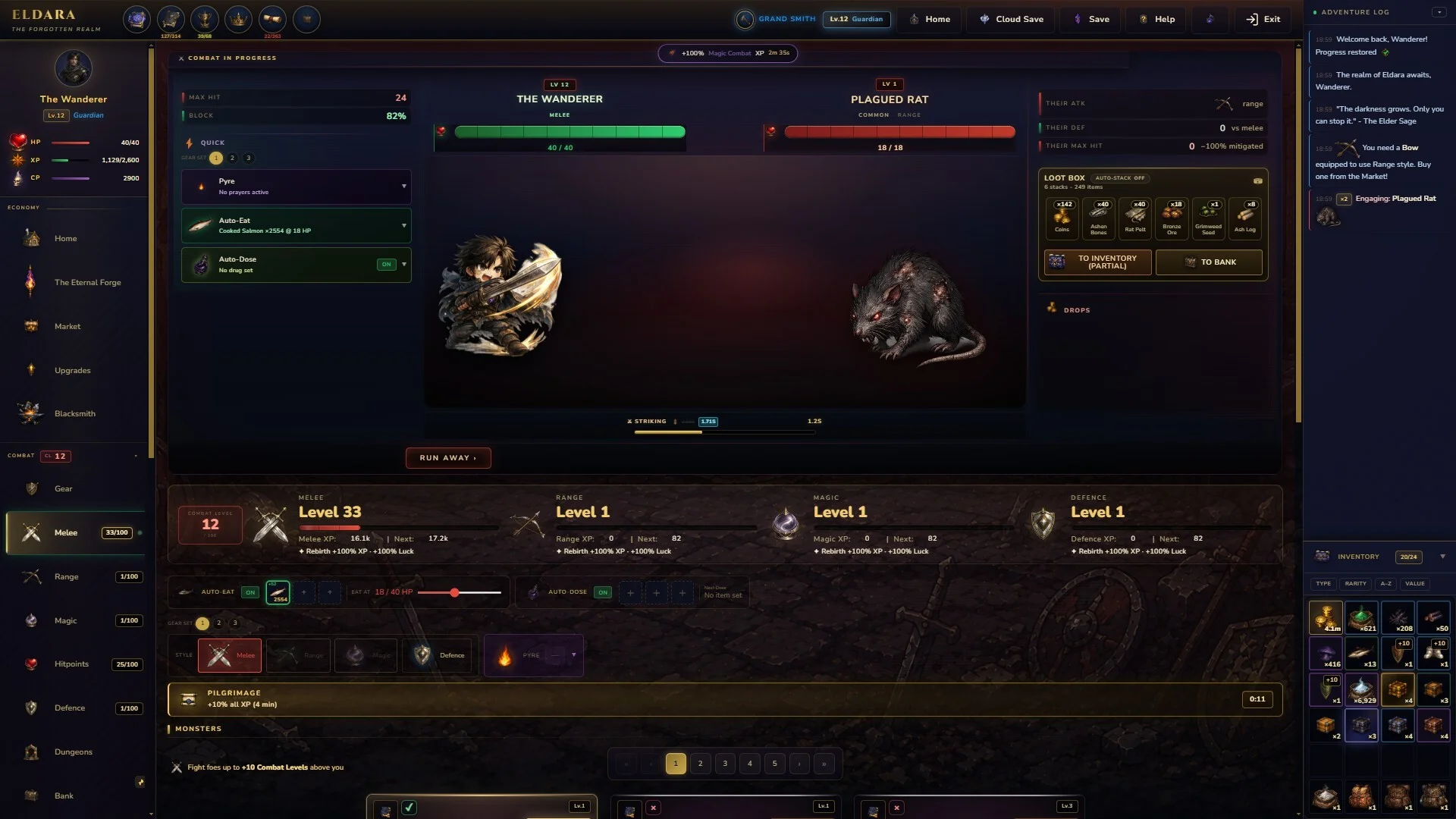
- Eldara steam offers a single-player dark fantasy idle RPG with persistent offline progress.
- Start broadly by training connected skills instead of focusing on only one activity.
- Crafting matters because gathered materials can support gear, alchemy, arrows, and other upgrades.
- Pets provide permanent bonuses tied to the skills they represent.
- Steam Deck support is listed as Playable, with adjustable difficulty and save-anytime accessibility features.
Eldara steam: What the Game Offers
Eldara steam is a single-player dark fantasy idle RPG built around long-term progression rather than constant active input. The realm continues developing while you are away, allowing training, gathering, hunting, and other activities to contribute to your next session. The full release arrived on September 2, 2026, following an Early Access period that began on June 15, 2026.
The central progression loop connects 17 skills, combat encounters, resource collection, crafting, pets, and story events. Instead of treating each system as a separate activity, plan them as parts of one economy. Mining can support smithing, fishing can provide materials from cursed waters, and combat can produce bones, hides, and rare components for later use.
The official Eldara Steam store page lists the game under Adventure, Casual, Indie, RPG, and Simulation. It also confirms single-player functionality, Steam Achievements, Steam Cloud, Family Sharing, and Steam Deck compatibility marked as Playable.
| Feature | Confirmed details | Why it matters |
|---|---|---|
| Core format | Single-player idle RPG | Progress can continue without constant active play |
| Skill system | 17 interconnected skills | Different activities can support one another |
| Pet system | 17 collectible pets | Each pet grants a permanent bonus to its domain |
| Achievement list | 68 Steam Achievements | Long-term goals are available beyond basic progression |
| Release status | Version 1.0 on September 2, 2026 | The game has moved beyond Early Access |
Skill Growth
Build progress through 17 skills, including combat, gathering, crafting, and support activities.
Dark Fantasy World
Explore ruined kingdoms, forgotten ruins, cursed waters, and story events shaped by the realm.
Companions
Collect 17 pets, each connected to a skill and its permanent progression bonus.
Idle Progress
Set an activity, step away, and return to continued progress without subscription-based systems.
Treat Eldara as a connected progression system. A skill that appears slower at first may become more valuable when it supplies materials for several other activities.
A Practical First-Session Setup
Your first session should establish a reliable activity cycle rather than chase every available feature at once. Begin by reviewing the skills and identifying which activities produce materials, which consume them, and which directly improve combat readiness. This approach gives each action a clear place in your wider progression plan.
The game’s description highlights Melee and Magic as combat-oriented examples, while fishing, mining, fletching, cremation, and cultivation represent additional paths. The source material does not publish a full skill-by-skill progression chart, so avoid assuming that one universal order is optimal. Instead, use the resource relationships visible in your current unlocks.
Choose a Starting Activity
Select a skill that matches your immediate objective. Use a combat activity when you want to hunt monsters, or choose gathering and production when you need materials for future crafting.
Check the Resource Chain
Before committing to a long idle session, inspect what the activity produces and what later upgrades may consume. Favor actions that support more than one part of your current plan.
Review Available Upgrades
Use collected items, recipes, and materials at the appropriate crafting station when possible. The listed crafting paths include smithing, alchemy, and fletching.
Assign Your Offline Session
Set the activity you want to continue while away, then return later to evaluate the results. Adjust the next activity based on shortages rather than following a fixed rotation.
| Starting goal | Useful activity direction | Follow-up |
|---|---|---|
| Improve combat readiness | Melee, Magic, or monster hunting | Convert drops into equipment or other upgrades |
| Build crafting resources | Mining, fishing, cultivation, or material gathering | Compare recipes before spending rare items |
| Support ranged equipment | Fletching and material collection | Prepare arrows and review the next crafting requirement |
| Explore progression variety | Rotate connected skills | Track which activities create the strongest resource links |
A good early routine is simple: choose an activity, allow progress to accumulate, inspect the output, and reinvest only where it advances your current objective. Because Eldara supports playing at your own pace, short active sessions and longer offline periods can both fit the same progression structure.
After every return session, spend a moment checking your new materials, recipes, skill milestones, and available upgrades. Small adjustments keep offline progress aligned with your next goal.
Skills, Crafting, and Combat Priorities
Eldara’s systems are designed around a living economy. The store description specifically presents skills as interconnected, meaning progress in one area can feed another. Combat produces loot, gathering creates inputs, and crafting turns those inputs into equipment or consumable progression options.
Monster hunting is especially important when you need bones, hides, or rare materials. These drops can be used across the smithy, alchemy bench, and fletching table. The most efficient choice depends on the recipe and upgrade currently available to you, so compare the cost of an upgrade with the value of holding materials for a later milestone.
| System | Examples named in the official description | Planning focus |
|---|---|---|
| Combat | Melee, Magic, monster hunting | Improve your ability to face creatures and reach deeper objectives |
| Gathering | Fishing, mining, cultivation | Build material reserves for connected production paths |
| Production | Smithing, alchemy, fletching | Turn drops and gathered resources into useful upgrades |
| Special activity | Cremation | Account for its role when planning bone-related or creature-drop progression |
| World activity | Encounters, merchants, subplots | Check unexpected opportunities before committing resources |
Combat Route
Prioritize hunting when your next objective requires monster drops, stronger equipment, or access to more dangerous ruins.
Production Route
Gather first when a recipe or upgrade clearly identifies the materials you lack.
Balanced Route
Alternate combat and gathering so your inventory grows without allowing one side of the economy to fall too far behind.
Do not treat every item as an immediate upgrade. Hundreds of items, recipes, and crafting paths are listed as part of the game’s feature set, so inventory decisions can affect several future activities. When a rare material appears, identify whether it belongs to an important recipe, equipment path, or pet-related milestone before using it.
Random encounters, traveling merchants, town criers, whispered subplots, and shadowy strangers also contribute to the world’s progression. These events create reasons to review the realm regularly rather than leaving one activity unattended indefinitely.
The available information does not establish a universal best build or fixed skill order. Keep rare materials until you understand their current recipe or upgrade value, especially when several crafting paths compete for them.
Pets, Achievements, and Long-Term Goals
Long-term progression in Eldara extends beyond skill levels. The game includes 17 unique pets, with one companion associated with each skill mastered. Examples listed by the developer include Steelfang the wolf pup, Sharpeye the hawk, Whisper the spectral familiar, and Sprout the seedling. Each pet grants a permanent bonus to its domain.
This makes pet collection a useful reason to broaden your progression plan. Rather than viewing a secondary skill as wasted effort, consider whether advancing it contributes toward its companion and the related permanent bonus. The exact unlock requirements for each pet are not published in the available store information, so track in-game objectives instead of relying on assumed thresholds.
Steam also lists 68 achievements, providing a structured set of milestones. Named examples include Goblin Smasher, Delver, Ironforge, and Pet Whisperer. These titles suggest goals connected to combat, exploration, crafting, and companion collection, although the complete requirements should be checked directly through the in-game or Steam achievement interface.
Long-Term Progression Checklist:
- Develop several of the 17 interconnected skills
- Collect pets connected to your active progression paths
- Use crafting stations for equipment, alchemy, and fletching needs
- Review the 68 Steam Achievements for new milestones
- Check random encounters and world events during active sessions
| Goal type | Confirmed target | Suggested tracking method |
|---|---|---|
| Skill mastery | 17 skills | Note which skills supply or consume your current resources |
| Companion collection | 17 pets | Record each unlocked pet and its domain bonus |
| Achievement progress | 68 achievements | Review the Steam achievement list after major milestones |
| World discovery | Encounters, merchants, subplots | Revisit active areas and inspect new event opportunities |
A practical checklist prevents idle progression from becoming aimless. Set one primary objective, such as preparing for a difficult hunt, and one secondary objective, such as advancing a gathering skill. This gives each session a clear direction without removing the flexibility that defines the idle format.
Use achievements and pet goals as reminders to vary your routine. They can help you notice valuable activities outside your current favorite skill.
Steam Features, Accessibility, and Requirements
The Steam listing provides several quality-of-life features that shape how Eldara can fit into different play styles. The game includes adjustable difficulty, save-anytime functionality, custom volume controls, support for play without quick-time events, and pacing designed around playing at your own speed.
Steam Deck compatibility is listed as Playable. The store page also confirms Steam Cloud, Family Sharing, and Steam Achievements. These features are useful for players who move between supported play environments or prefer shorter sessions throughout the day.
| Category | Minimum | Recommended |
|---|---|---|
| Operating system | Windows 10, 64-bit | Windows 10 or 11, 64-bit |
| Processor | Intel Core i3 or AMD equivalent | Intel Core i5 or AMD Ryzen 5 |
| Memory | 2 GB RAM | 4 GB RAM |
| Graphics | Not specified | Dedicated GPU or modern integrated graphics |
| DirectX | Version 11 | Version 12 |
| Storage | 500 MB | 1 GB |
The store page lists English interface and subtitles. It does not list full audio for English, and the available language table identifies English as the supported language in the displayed configuration. Check the live Steam page before purchase if language availability is important to your setup.
The page also discloses that some visual assets, including monster portraits, pet illustrations, item icons, and character artwork, were created with AI image-generation tools. The developer states that no live AI generation, AI dialogue, or AI-driven content is used during gameplay.
For a smooth first launch, confirm your operating system, available storage, and preferred audio settings before beginning a long idle activity.
Eldara Steam FAQ
Q: What type of game is Eldara on Steam?
Eldara is a single-player dark fantasy idle RPG with Adventure, Casual, Indie, RPG, and Simulation tags. Its main systems include 17 skills, monster hunting, crafting, pets, random encounters, and offline progress.
Q: When did Eldara release on Steam?
The Version 1.0 release date listed on Steam is September 2, 2026. The Early Access release date was June 15, 2026.
Q: Does Eldara support offline progress?
Yes. The official description says players can set an activity, step away, and return stronger through offline progress. The game is designed to support a flexible pace rather than constant active play.
Q: Is Eldara playable on Steam Deck?
Steam lists Eldara as Playable on Steam Deck. The store page also lists Steam Cloud, Family Sharing, adjustable difficulty, save-anytime support, and gameplay that does not require quick-time events.
Build your Eldara routine around connected skills, deliberate crafting choices, and clear milestone goals. That structure makes both active sessions and offline progress more meaningful.