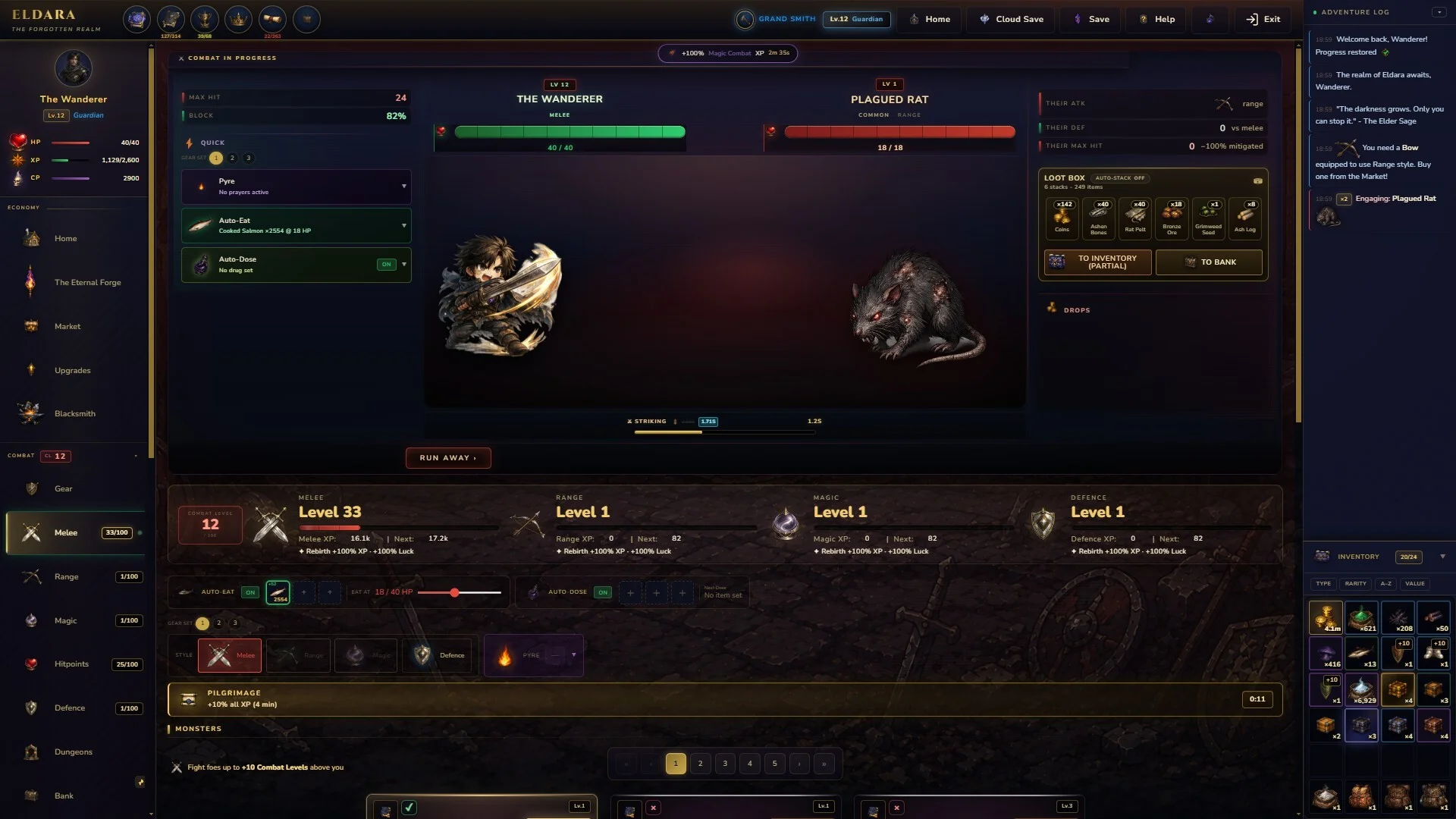
- Eldara game combines dark fantasy exploration with idle RPG progression and offline gains.
- Seventeen skills form an interconnected economy where gathering supports crafting and combat.
- Combat progression centers on hunting monsters, collecting materials, and improving gear.
- Pets provide permanent bonuses linked to the skills you develop.
- Best routine: set a sustainable activity, gather materials, craft upgrades, then pursue harder encounters.
Eldara game progression fundamentals
Eldara game is a single-player dark fantasy idle RPG built around steady advancement rather than short sessions. The official store description presents a realm where training, hunting, gathering, crafting, and exploration continue to support progress even when you step away. That design makes planning more important than constant input.
The game reached Version 1.0 on September 2, 2026, following an Early Access period that began on June 15, 2026. Its core structure is straightforward: develop skills, collect resources, turn those resources into equipment or useful items, and use better preparation to face stronger threats.
Choose an activity that produces materials you can use immediately. A balanced loop of gathering, crafting, and combat usually creates more useful progress than focusing on a single category without supporting resources.
Train
Build one of the game's 17 skills and work toward its passives and milestones. Skill growth is the foundation of long-term progression.
Gather
Fishing, mining, and other resource activities supply the materials needed for equipment, recipes, and future upgrades.
Hunt
Defeat monsters across ruined kingdoms and forgotten locations to obtain bones, hides, and rare materials for advancement.
| Progression layer | Main purpose | Useful habit |
|---|---|---|
| Skills | Unlock passives, milestones, and production options | Develop complementary skills instead of only one activity |
| Resources | Supply crafting and equipment upgrades | Keep gathering active while away |
| Crafting | Convert drops and materials into stronger tools or gear | Craft after identifying your next combat goal |
| Combat | Earn loot and test progression | Increase difficulty only when upgrades are affordable |
| Pets | Add permanent bonuses to skill domains | Match pet development with your preferred activity |
The most important early decision is not a class selection or fixed build. Instead, it is deciding which activities support one another. A combat-focused routine benefits from material gathering and equipment production. A gathering-focused routine still needs enough combat strength to access better drops and survive encounters.
The official Eldara Steam page lists adjustable difficulty, save-anytime functionality, custom volume controls, and play-at-your-own-pace accessibility features. These options support a flexible routine for players who prefer short check-ins or longer planning sessions.
How the 17-skill economy works
Eldara's defining system is its network of 17 fully featured skills. The store description emphasizes that each skill has unique passives and milestones, and that activities feed into one another as part of a living economy. This means skill progression should be viewed as a connected system rather than seventeen isolated tracks.
Known activity examples include Melee, Magic, fishing, mining, fletching, cremation, and cultivating ancient herbs. The exact value of each activity depends on your current objectives. A skill that appears less useful at first may become important when a recipe, passive, or combat preparation requires its output.
Whenever you select a skill to train, identify at least one skill that consumes its output and one activity that supplies materials for it. This keeps your progression loop productive.
| Skill activity | Primary role | Best paired with |
|---|---|---|
| Melee | Direct combat progression | Hunting, smithing, equipment crafting |
| Magic | Spell-based combat progression | Hunting, resource gathering, upgrade materials |
| Fishing | Resource production from cursed waters | Cooking or other recipe paths when available |
| Mining | Deep-vein material gathering | Smithing and gear improvement |
| Fletching | Arrow production | Hunting and ranged preparation |
| Herb cultivation | Ancient plant resource gathering | Alchemy and long-term preparation |
| Cremation | Processing bones from defeated creatures | Monster hunting and material management |
These pairings are practical planning categories, not rigid character classes. Eldara encourages experimentation because skills have unique passives and milestones. If a resource begins accumulating faster than you can use it, redirect the next training period toward a related production or combat skill.
A practical skill rotation
Use a rotation with three stages:
- Supply stage: Gather the material needed for your next recipe, upgrade, or activity.
- Conversion stage: Use the smithy, alchemy bench, or fletching table to turn materials into useful outputs.
- Testing stage: Hunt or explore to determine whether the new equipment and passive bonuses justify a harder objective.
This approach reduces wasted inventory and gives every training session a measurable purpose. It also works well with offline progression because you can set a longer activity before leaving the game.
| Goal | First activity | Supporting activity | Progress check |
|---|---|---|---|
| Improve melee readiness | Hunt for drops | Mine and smith materials | Confirm the next gear upgrade is affordable |
| Prepare ranged supplies | Gather materials | Train fletching | Maintain enough arrows for planned encounters |
| Strengthen magic progression | Train Magic | Gather rare materials | Check whether the next spell-related milestone is reachable |
| Expand crafting options | Mine or gather herbs | Smithing or alchemy | Track recipes that consume current stock |
| Build general momentum | Use a reliable idle activity | Rotate into combat periodically | Compare resources gained with resources spent |
A productive session should leave you with one of three results: a new milestone, a completed upgrade, or materials that directly support your next objective.
Combat, crafting, and gear improvement
Combat in Eldara is tied closely to the wider economy. Monsters found across crumbling kingdoms and forgotten ruins provide bones, hides, and rare materials. Those drops can be used at crafting stations, including the smithy, alchemy bench, and fletching table.
The safest progression method is to treat every difficult encounter as a resource test. Before increasing the challenge, confirm that your current gathering and crafting loop can replace the materials you expect to spend. This prevents a combat push from stopping your broader advancement.
Higher-level encounters may offer better rewards, but they also expose weak links in your preparation. Improve the supporting skill or crafting path first when an upgrade is too expensive to sustain.
Choose a Clear Combat Objective
Decide whether the next goal is stronger gear, a rare material, a new region, or progress toward the Void. A specific target makes resource planning easier.
Stock the Required Materials
Gather the resources needed for weapons, armor, arrows, alchemical items, or other relevant recipes. Use offline progress for dependable resource accumulation.
Craft Before Increasing Difficulty
Visit the appropriate crafting path and convert available drops into an upgrade. Prioritize improvements that support your main combat style.
Test the Encounter
Hunt the chosen monster or explore the selected ruin. Watch whether the activity produces enough value to justify its material cost.
Return to the Economy Loop
After combat, process drops and begin the next supply cycle. Keep useful materials moving into recipes rather than allowing the inventory to become unplanned storage.
| Combat objective | Preparation priority | Expected benefit |
|---|---|---|
| Hunt common monsters | Reliable gear and basic supplies | Consistent materials for early crafting |
| Pursue legendary beasts | Stronger combat skills and upgraded equipment | Access to valuable drops and advanced progression |
| Explore ruins | Sustainable healing or support preparation | Broader encounters and rare resources |
| Approach the Void | Multiple trained skills and completed upgrades | A late-stage test of overall progression |
Eldara also includes 68 Steam Achievements, with examples such as Goblin Smasher, Delver, Ironforge, and Pet Whisperer. Achievements can serve as optional milestones, but they should not replace the main progression loop. Use them to identify activities you may want to revisit after your core equipment and skills are stable.
The game supports Steam Cloud and is marked as playable on Steam Deck according to the store listing. Those features are useful for a progression style built around intermittent sessions, especially when offline gains and save-anytime access are part of your routine.
Pets, offline progress, and daily routines
Eldara includes 17 collectible pets, with one associated with each skill mastered. The listed examples include Steelfang, a wolf pup; Sharpeye, a hawk; Whisper, a spectral familiar; and Sprout, a seedling. Each pet provides a permanent bonus to its domain, making companion collection part of long-term account development.
Pet bonuses should be evaluated alongside your current bottleneck. If mining materials are delaying several upgrades, a mining-related companion may provide more immediate value than a pet connected to a skill you rarely use. However, broad development remains useful because the game connects its skills through crafting and resource chains.
Choose the companion that supports the activity currently limiting your progress. Revisit that choice when your main resource shortage changes.
| Companion example | Associated theme | Planning use |
|---|---|---|
| Steelfang | Wolf pup and combat identity | Supports a combat-oriented progression theme |
| Sharpeye | Hawk and precision | Fits ranged or scouting-focused preparation |
| Whisper | Spectral familiar | Represents magic or supernatural progression |
| Sprout | Seedling and cultivation | Supports herb and gathering development |
Recommended idle routine
Use the following routine when you want Eldara to keep progressing between active sessions:
- Select a skill that produces a material needed for your next upgrade.
- Check whether the activity has enough inventory space and a clear purpose.
- Leave the game running through its offline-friendly progression cycle.
- Return to process materials and review skill milestones.
- Change activities only when a new bottleneck appears.
The world also includes random encounters, traveling merchants, town criers, whispered subplots, and shadowy strangers. These systems give the idle structure a changing layer of discovery. Pay attention to unexpected events instead of treating every return session as a simple claim-and-exit routine.
| Session length | Recommended focus | Reason |
|---|---|---|
| Short check-in | Collect progress and process materials | Keeps inventory and crafting decisions current |
| Medium session | Complete a supply-to-crafting cycle | Turns passive gains into measurable upgrades |
| Long session | Hunt, explore, and pursue milestones | Uses prepared resources for active progression |
| Away from the game | Set a dependable gathering or training activity | Converts idle time into future options |
Offline progress is most valuable when it is attached to a specific next action. Decide what the materials are for before starting a long idle period.
Milestones, checklist, and long-term goals
Eldara's long-term structure combines skill milestones, pet collection, crafting paths, monster hunting, achievements, and the eventual goal of facing the Void. Because the game offers seventeen interconnected skills, completion is better approached as a sequence of dependable targets rather than one large checklist.
The following milestones create a practical progression order without forcing every player into the same build:
Core Eldara Goals:
- Establish a reliable gathering and crafting loop
- Train complementary combat and production skills
- Craft upgrades using monster drops and gathered materials
- Unlock pets that support current skill bottlenecks
- Complete selected achievements while preparing for the Void
| Milestone | What to confirm | Why it matters |
|---|---|---|
| First stable loop | Gathering produces materials used by crafting | Prevents idle time from becoming disconnected progress |
| First major upgrade | The upgrade improves a current combat or production bottleneck | Gives the next cycle a clear purpose |
| Companion expansion | A pet supports an important skill domain | Adds a permanent bonus to future sessions |
| Advanced crafting | Multiple material paths are working together | Improves access to stronger equipment and recipes |
| Void preparation | Skills, gear, and resources are developed together | Tests the full progression system |
A one-time purchase model is listed on the official store page, along with the developer's statement that Eldara has no microtransactions or pay-to-win systems. The Steam listing showed an introductory offer of $5.25 after a 30% discount, scheduled to end on September 16, 2026. Prices and promotions can change, so verify the current listing before purchasing.
Eldara also discloses the use of AI-generated visual assets, including some monster portraits, pet illustrations, item icons, and character artwork. The developer states that these assets are pre-generated and shipped with the game rather than created live during gameplay.
Achievements and pet collection add useful targets, but your main progression should remain centered on skills, resources, crafting, and combat readiness.
Q: What type of game is Eldara?
Eldara is a single-player dark fantasy idle RPG with adventure, casual, indie, RPG, and simulation elements. Its main systems include skill training, monster hunting, crafting, pets, random encounters, and offline progress.
Q: How many skills and pets are in Eldara?
The game features 17 fully featured skills and 17 collectible pets. Each pet provides a permanent bonus connected to its skill domain.
Q: What should new players focus on first?
Start with a sustainable gathering and crafting loop. Develop complementary skills, process materials into useful upgrades, and increase combat difficulty only when your economy can support it.
Q: Does Eldara support offline progress?
Yes. Eldara is designed to let players set an activity, step away, and return with progress. The best results come from assigning offline time to a specific resource or milestone goal.