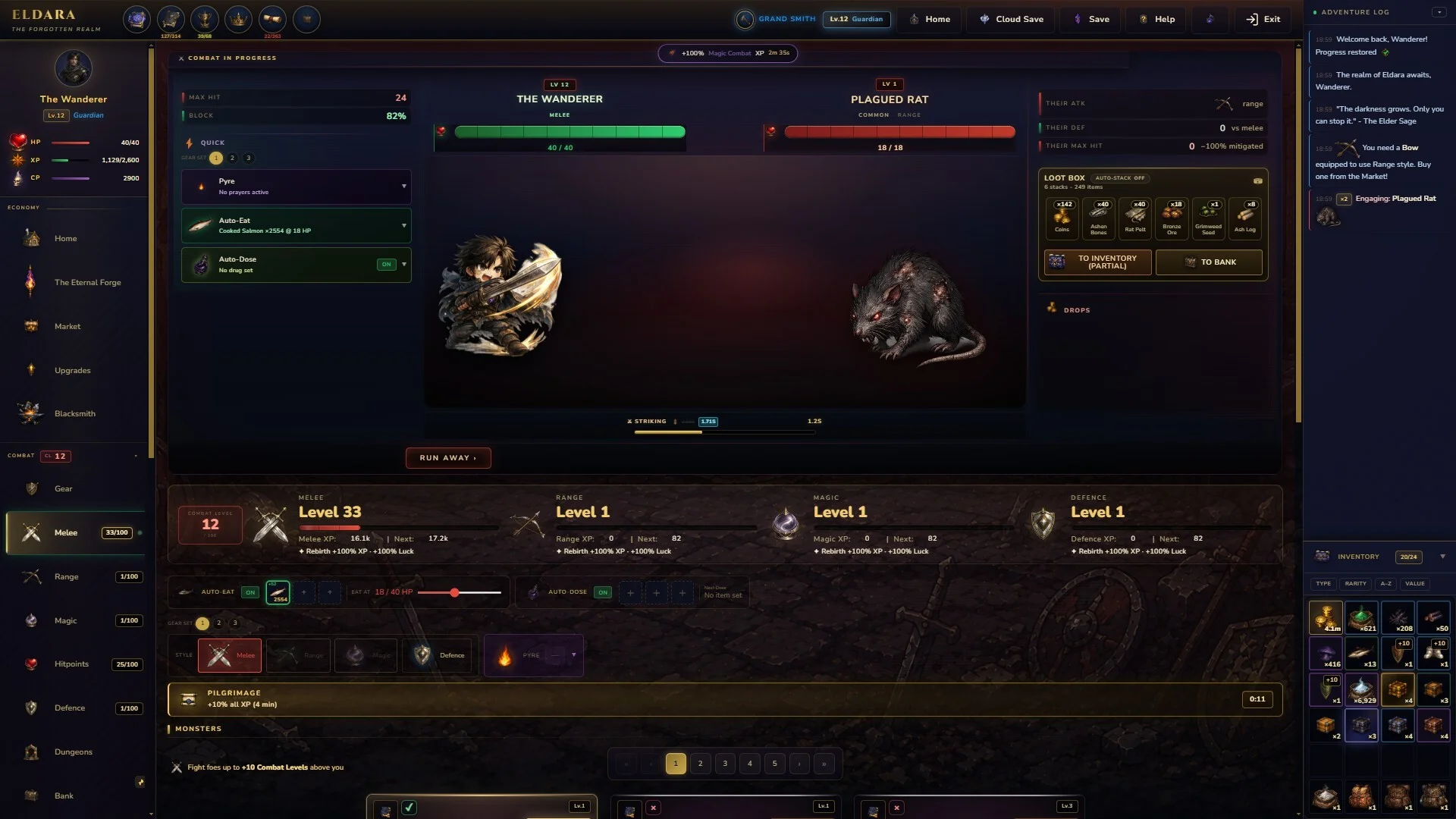
- Eldara idle game progression centers on 17 connected skills and long-term planning
- Best opening plan: choose one primary activity, then support it with gathering and crafting
- Combat growth comes from hunting monsters, collecting materials, and improving equipment
- Pet collection adds permanent bonuses tied to the skills you develop
- Offline progress lets you set an activity, leave the realm, and return to continued advancement
Eldara Idle Game Overview
The Eldara idle game is a dark fantasy RPG built around steady progression rather than short sessions alone. Its central loop combines training, hunting, gathering, crafting, exploration, and offline advancement. The official store listing describes a realm where the world continues moving while you are away, allowing your selected activity to keep contributing to long-term growth.
Eldara launched into Version 1.0 on September 2, 2026, following an Early Access release on June 15, 2026. It is presented as a single-player experience with Steam achievements, Steam Cloud support, Family Sharing, adjustable difficulty, save-anytime functionality, and play at your own pace.
| Feature | Confirmed details |
|---|---|
| Genre | Adventure, Casual, Indie, RPG, Simulation |
| Developer | Eldara Games |
| Publisher | Eldara Games |
| Full release | September 2, 2026 |
| Early Access release | June 15, 2026 |
| Main progression | 17 skills, combat, crafting, pets, offline progress |
| Achievements | 68 Steam Achievements |
| Player mode | Single-player |
| Languages | English interface and subtitles |
Skill Network
Train 17 skills that support one another through gathering, combat, production, and utility-focused progression.
Dark Fantasy Combat
Hunt monsters across ruined kingdoms and forgotten locations while collecting bones, hides, and rare materials.
Persistent Growth
Set an activity, step away, and return to continued progress without relying on constant active input.
Treat every skill as part of a wider economy. A strong early plan supports your main activity instead of leveling unrelated skills without a purpose.
The most useful way to understand Eldara is as a connected progression system. Melee and Magic represent direct combat paths, while activities such as Fishing, Mining, Fletching, Cremation, and Herb cultivation contribute resources or production options. The store listing also highlights random encounters, traveling merchants, town criers, whispered subplots, and shadowy strangers, so exploration is not limited to combat rewards.
For current feature details and launch information, see the official Eldara Steam store page.
Build a Strong Skill Progression Plan
Eldara’s 17 skills are designed to interlock. That means your first objective should not be to spread experience evenly across every available activity. Instead, establish a core loop with one main progression target and several supporting skills.
A practical beginner structure is:
- Select a primary skill that matches your preferred activity.
- Identify the gathering skill that supplies its materials.
- Add a production skill that turns those materials into useful equipment or supplies.
- Keep combat progression close enough to handle stronger monsters and access better drops.
- Use offline sessions to maintain the activity that is hardest to manage actively.
The source listing names several specific activities, but it does not provide exact experience rates, unlock levels, or skill rankings. For that reason, the table below focuses on functional roles rather than unsupported numerical claims.
| Skill or activity | Likely role in the progression loop | Best planning use |
|---|---|---|
| Melee | Close-range combat path | Build around direct monster hunting and equipment upgrades |
| Magic | Spell-based combat path | Support a ranged or ability-focused combat approach |
| Fishing | Resource gathering | Use as a steady activity when you want passive resource growth |
| Mining | Material gathering | Pair with smithing and equipment-focused progression |
| Fletching | Ranged equipment production | Connect gathered materials with ranged combat preparation |
| Cremation | Beast-related resource processing | Consider when monster drops include usable remains |
| Herb cultivation | Ancient plant production | Support alchemy-oriented crafting and resource preparation |
| Crafting paths | Item and gear production | Convert gathered materials into progression upgrades |
Choose a Primary Direction
Start with the activity you expect to use most often. Melee and Magic are the clearest combat anchors, while gathering skills provide a slower but reliable foundation for resource growth.
Add One Gathering Support
Identify the resource category your chosen direction needs. Mining, Fishing, herb cultivation, and monster hunting each support different parts of Eldara’s economy.
Select a Production Link
Use smithing, alchemy, fletching, or another available crafting path to turn materials into useful gear, consumables, or progression items.
Review Before Switching
Before abandoning an activity, check whether it is supplying another skill. Switching too frequently can slow the development of a connected progression loop.
The strongest early plan is usually a focused triangle: one main activity, one resource source, and one crafting or combat payoff.
Avoid judging a skill only by its immediate reward. A resource that appears modest at first may become more valuable when it feeds a crafting chain. Similarly, a combat activity may offer materials that improve more than one part of your account.
Combat, Crafting, and Monster Hunting
Combat in Eldara is closely connected to the item economy. The official description emphasizes hunting monsters, collecting bones and hides, discovering rare materials, and forging equipment through several workstations. This makes each encounter part of a broader upgrade cycle rather than an isolated battle.
The most reliable combat routine is to keep your equipment and production skills moving together. When a new material becomes available, consider whether it can improve your current gear, unlock a recipe, or support another activity. This approach helps reduce wasted resources and keeps the loop purposeful.
| Combat stage | Main objective | Useful supporting action |
|---|---|---|
| Preparation | Establish a dependable combat activity | Maintain gathering and crafting resources |
| Hunting | Defeat monsters in available regions | Collect bones, hides, and rare materials |
| Processing | Turn drops into useful materials | Use smithing, alchemy, or fletching paths |
| Upgrading | Improve readiness for stronger encounters | Reinvest valuable drops into equipment |
| Advancement | Prepare for difficult objectives | Balance combat growth with resource production |
The listed crafting options include a smithy, an alchemy bench, and a fletching table. Each suggests a different way to convert drops and gathered materials into progress:
- The smithy supports equipment built around metal and weapon improvement.
- The alchemy bench gives herbs and other gathered materials a production purpose.
- The fletching table connects materials to arrows and ranged preparation.
- Monster remains can become valuable when paired with the right processing path.
- Rare materials should be reserved for upgrades that support your current combat direction.
Eldara highlights hundreds of items, recipes, and crafting paths. Keep unusual materials available until you understand which upgrade or recipe best supports your chosen route.
A good hunting session should answer three questions:
- Does the target provide materials needed by your current build?
- Can those materials improve equipment or unlock a useful crafting path?
- Is the activity sustainable when you return after an offline period?
If the answer is yes to at least two questions, the target is likely contributing to your wider progression. If not, a gathering or crafting session may provide better value until your equipment catches up.
The game also includes 68 Steam Achievements, with listed examples such as Goblin Smasher, Delver, Ironforge, and Pet Whisperer. These achievements indicate that progression covers combat, exploration, crafting, and companion collection rather than focusing on a single activity.
Pets, Encounters, and Offline Progress
Companions are one of Eldara’s clearest long-term progression systems. The store description lists 17 unique pets, with one associated with each mastered skill. Examples include Steelfang the wolf pup, Sharpeye the hawk, Whisper the spectral familiar, and Sprout the seedling. Each companion grants a permanent bonus to its related domain.
Because pets provide permanent bonuses, they are best viewed as milestones rather than short-term consumables. Developing a broad skill portfolio can therefore have value even after you establish a preferred main activity.
| Companion example | Associated theme | Planning takeaway |
|---|---|---|
| Steelfang | Wolf and combat | Supports the broader monster-hunting identity |
| Sharpeye | Hawk and precision | Fits ranged or perception-oriented progression |
| Whisper | Spectral familiar | Represents Eldara’s magic and dark-fantasy tone |
| Sprout | Seedling and cultivation | Connects to herb-based resource development |
The realm also features random encounters, traveling merchants, town criers, whispered subplots, and shadowy strangers. These systems add reasons to check the world beyond a single training screen. Since the available information does not list encounter tables or exact rewards, approach them as opportunities to investigate rather than guaranteed sources of a specific item.
Offline progress is most effective when used deliberately:
- Set a skill that supports your current build before leaving.
- Choose a resource activity when your next upgrade depends on materials.
- Use a production-oriented activity when you already have a healthy resource stockpile.
- Check your results when you return and redirect progress toward the next bottleneck.
- Avoid changing activities simply because one short session produced a smaller reward.
Offline progress is most valuable when it targets a known need: materials for crafting, steady skill growth, or preparation for your next combat objective.
Eldara’s accessibility features also support flexible play. The listing confirms adjustable difficulty, save anytime, custom volume controls, no required quick-time events, and gameplay at your own pace. These options make it easier to fit progression around your preferred session length.
A Practical First-Session Checklist
The first session should establish direction, not force you to master every system. Eldara contains 17 skills, 17 pets, hundreds of items and recipes, dynamic chat events, random encounters, and offline progression. A focused opening reduces confusion and gives each activity a clear purpose.
First-Session Goals:
- Choose a primary combat or gathering direction
- Identify one resource skill that supports your main activity
- Test a crafting path such as smithing, alchemy, or fletching
- Set an activity before leaving to use offline progress
- Review available encounters, achievements, and companion milestones
Use the following review cycle whenever you return to the game:
| Review question | If the answer is yes | If the answer is no |
|---|---|---|
| Did the activity produce useful materials? | Continue or convert them through crafting | Change to a resource-producing activity |
| Did your equipment improve? | Move toward a stronger combat target | Prioritize the relevant crafting path |
| Did a skill unlock a new option? | Add it to your progression loop | Keep building the current support skill |
| Did you gain a pet milestone? | Continue developing that skill domain | Broaden your skill plan carefully |
| Did an encounter reveal a lead? | Investigate the new opportunity | Return to your planned activity |
The game supports save-anytime play, so there is no need to treat every session as a single uninterrupted run. Save after meaningful progress, especially after gathering valuable materials, completing an upgrade, or changing your primary activity.
When you come back, collect progress, inspect new materials, craft the most useful upgrade available, then choose the next activity before exploring further.
This routine keeps active decisions short while preserving the satisfaction of long-term growth. It also makes the idle structure easier to understand: active play is used for decisions and discovery, while offline time supports the plan you already created.
Eldara Launch Facts and FAQ
Eldara reached Version 1.0 on September 2, 2026, after its Early Access period began on June 15, 2026. The listed PC requirements are modest, with a minimum of 2 GB RAM and 500 MB of storage, while the recommended specification lists 4 GB RAM and 1 GB of storage. The official page also marks the game as playable on Steam Deck.
| Requirement | Minimum | Recommended |
|---|---|---|
| Operating system | Windows 10, 64-bit | Windows 10 or 11, 64-bit |
| Processor | Intel Core i3 or AMD equivalent | Intel Core i5 or AMD Ryzen 5 |
| Memory | 2 GB RAM | 4 GB RAM |
| Graphics | DirectX 11 support | Dedicated GPU or modern integrated graphics, DirectX 12 |
| Storage | 500 MB | 1 GB |
| Other | 64-bit processor and OS | 64-bit processor and OS |
Q: What is the Eldara idle game?
Eldara is a dark fantasy single-player RPG built around idle progression, 17 interconnected skills, monster hunting, crafting, pets, encounters, and offline advancement.
Q: How many skills are available in Eldara?
The official game description lists 17 fully featured skills with unique passives and milestones. Named examples include Melee, Magic, Fishing, Mining, Fletching, Cremation, and herb cultivation.
Q: How does offline progress work?
You set an activity before stepping away, then return later to collect continued progress. The best choice depends on whether you currently need skill growth, materials, or crafting preparation.
Q: How many pets can be collected?
Eldara lists 17 unique pets, with one associated with each skill mastered. Each pet provides a permanent bonus connected to its domain.
Eldara rewards focused planning: connect skills, process useful materials, develop companion milestones, and let offline progress support your next goal.
For launch-specific information, supported features, achievements, system requirements, and future announcements, use the official Eldara Steam page. Details such as prices, discounts, and review totals can change over time, so always confirm them directly on the store page.