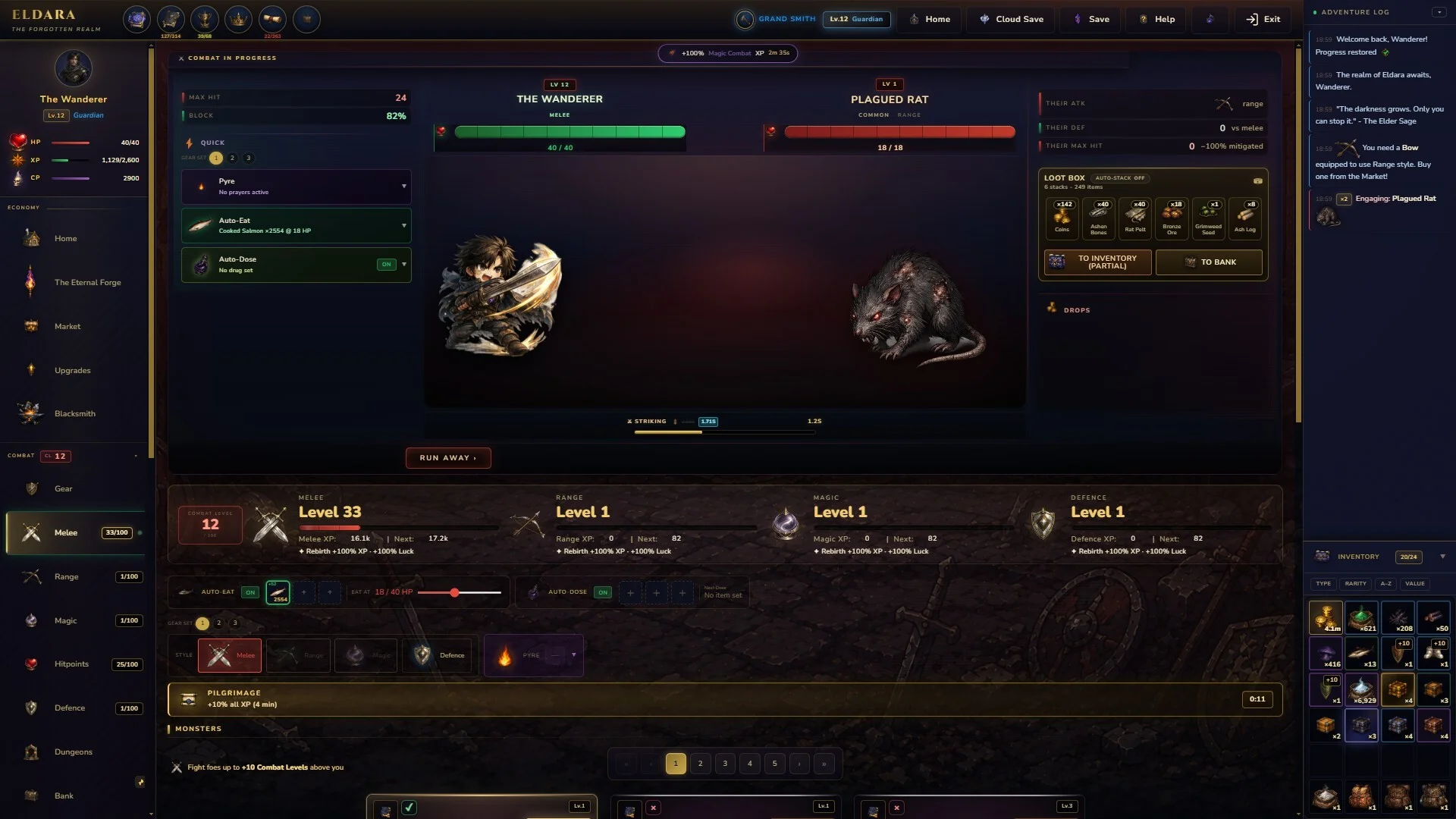
- Eldara leveling works best when quests, combat, skills, and gear progress together.
- Quest rewards can create large level jumps, so avoid investing heavily before checking objectives.
- Combat order favors melee first, ranged second, and mage third during early progression.
- Perks and gear provide long-term value beyond raw skill levels and should guide your upgrades.
- Prestige and mastery add replay value, making efficient repeatable activities important later.
Eldara leveling foundations
Eldara leveling is built around an idle RPG loop where skills continue progressing while you manage quests, combat, resources, equipment, and unlocks. The most reliable approach is not to focus on one number alone. Instead, build a character whose combat level, gathering options, gear, perks, and faction progress support one another.
The early game is intentionally straightforward. Menus clearly identify quests, enemies, materials, and equipment, so new players can follow the visible objectives without needing a rigid route. That clarity makes it easier to create a repeatable routine: accept useful tasks, fight an appropriate enemy, collect materials, improve equipment, and return to progression systems when timers or rewards are ready.
The game includes Normal, Accelerated Growth, and Hardcore modes. These modes change how carefully you should approach progression. Normal is the safest environment for learning the skill system, while Accelerated Growth is useful when you want to test later milestones more quickly. Hardcore demands greater attention to equipment and combat readiness because a poor upgrade decision can carry more serious consequences.
| Mode | Best use | Leveling priority | Main concern |
|---|---|---|---|
| Normal | First progression run | Learn quests, skills, and combat | Avoid wasting major rewards |
| Accelerated Growth | Faster system testing | Compare builds and unlock paths | Progress may feel less representative |
| Hardcore | High-risk challenge | Maintain gear and survival margins | Do not enter uncertain fights |
Quest Progression
- Clear objectives with visible rewards
- Watch for large skill-level jumps
- Use turn-in timing deliberately
Idle Skills
- Keep useful activities running
- Match gathering to current needs
- Build support skills alongside combat
Combat Growth
- Upgrade before pushing harder enemies
- Use appropriate gear for your style
- Return to mastered targets when efficient
Treat every quest reward as part of your build plan. A large experience payment may unlock new content, but it can also make earlier training feel inefficient if accepted without preparation.
Step-by-step Eldara leveling route
A strong progression route should reduce idle downtime while keeping your character ready for the next unlock. You do not need to manually control every action. The goal is to make each background activity support the next active decision.
Choose a stable starting mode
Begin with Normal mode if you are learning Eldara’s systems. Use the opening period to understand how quests, combat, skills, materials, and equipment interact. Accelerated Growth can be useful for experimentation, while Hardcore is better saved for a run where you already understand enemy requirements.
Accept objectives before training
Check available quests before committing to long skill sessions. Some objectives may award substantial experience or unlock progress that changes your immediate priorities. Complete the required combat, gathering, or preparation work first, then decide whether the reward should be claimed immediately.
Build combat around your current gear
Early combat progression generally begins with melee, followed by ranged and then mage access. Do not force a preferred style before the necessary equipment and progression are available. A practical build uses the strongest compatible gear rather than selecting a weapon type in isolation.
Rotate resources into upgrades
Use gathering and hunting activities to support equipment, market upgrades, and perk unlocks. If a skill is leveling but produces nothing useful for your current goals, shift attention toward materials or activities connected to the next upgrade.
Repeat efficient targets and prepare for prestige
Once a monster or activity becomes reliable, repeat it for rewards and mastery rather than always pushing into uncertain content. Later, prestige and rebirth systems make repeatable progression valuable, so learn which activities remain efficient after a reset.
| Progress stage | Main action | Supporting action | Checkpoint |
|---|---|---|---|
| Opening | Follow introductory quests | Start a useful idle skill | Basic gear and first objectives understood |
| Early growth | Complete combat and skill tasks | Gather upgrade materials | Next quest requirements are visible |
| Mid progression | Improve perks and equipment | Build faction reputation | More permanent bonuses become available |
| Advanced growth | Farm reliable enemies | Raise monster mastery | Repeatable targets are identified |
| Rebirth cycle | Prestige when prepared | Rebuild around permanent bonuses | Reset improves the next run |
Higher-level content is not automatically better experience. If an enemy consumes too many resources or forces repeated failures, a stable target with useful drops may produce stronger overall progression.
Combat, skills, and equipment priorities
Combat is one of the clearest ways to connect Eldara leveling with the rest of the game. Enemies provide experience, gold, materials, gear opportunities, and mastery progress. However, the best target depends on more than its displayed level. You should compare survival reliability, reward quality, equipment needs, and whether the target advances a current quest.
Early combat follows a practical order: melee becomes available first, ranged follows, and mage generally comes later. This does not mean one style is permanently superior. It means your initial plan should respect the progression curve instead of assuming every combat style is available immediately.
Gear should match the role of the activity. Heavy equipment may be valuable for a durable melee setup but less suitable for a character built around ranged or magic progression. When an upgrade offers a modest stat increase but also enables a new activity, quest, or enemy tier, its utility may exceed the visible number.
| Combat focus | Strength | Leveling role | Recommended approach |
|---|---|---|---|
| Melee | Earliest access and direct durability | Reliable opening combat | Use for stable early targets |
| Ranged | Safer distance-based progression | Useful after early unlocks | Pair with suitable ranged equipment |
| Mage | Later access and specialized growth | Advanced progression option | Build toward it instead of forcing it early |
| Monster mastery | Repeated-target bonuses | Long-term farming value | Return to worthwhile enemies regularly |
Skills should be evaluated by purpose rather than level alone. Some skills directly improve combat, while others provide materials, gold, gear access, or broader unlocks. A balanced account may progress more smoothly than one that pushes a single skill while neglecting the systems that support it.
The perk structure also matters. Eldara uses tiers of unlocks connected to skills, items, market upgrades, hunting, and other progression choices. These bonuses can improve future sessions, which means an upgrade that looks slower in the short term may be valuable across multiple activities.
Prioritize upgrades that improve both current output and future options. A new perk, better gear set, or useful material source can be more valuable than a small isolated level increase.
Quests, perks, factions, and mastery
Quests are important acceleration tools, but they should not replace the rest of your progression plan. Large quest rewards can move a skill through many levels at once. That feels powerful, yet it may also remove the reason to train the earliest levels manually. Use quests to unlock systems and reach meaningful thresholds, while maintaining enough ordinary training to understand the skill’s role.
Faction reputation provides another layer of long-term planning. Reputation unlocks additional perks, and committing to a faction can provide permanent bonus perks. Because these benefits can influence later runs, avoid treating faction selection as a temporary reward choice. Compare the bonuses with your preferred combat and gathering routine before locking in a direction.
The Adventure Log adds activity between normal training cycles. Random merchants, resource or gear crates, skill-buff events, and faction-leveling interactions can offer useful diversions. These events are especially valuable when they overlap with a current goal, such as preparing for a quest requirement or improving a resource bottleneck.
| System | Immediate value | Long-term value | Efficient use |
|---|---|---|---|
| Quests | Experience and progression rewards | Unlocks and milestone access | Check requirements before training |
| Skill perks | Better activity performance | Stronger future sessions | Invest where the skill supports your build |
| Faction reputation | Access to extra perks | Permanent bonus potential | Match the faction to your preferred routine |
| Adventure Log | Random resources and buffs | More active variety | Check events between idle cycles |
| Monster mastery | Better repeat-target rewards | Efficient farming after resets | Focus on enemies worth repeating |
Monster Battle Mastery rewards repeated combat against the same enemy. Targets can be advanced through multiple mastery tiers, with the system reaching up to 10 tiers for a mob. At mastery level 10, a special feature can improve gold and drop returns for that enemy. This makes targeted farming a reasonable choice when a monster has materials or rewards you still need.
Keep a short list of three priorities: the next quest requirement, the next meaningful upgrade, and the best repeatable enemy. This prevents random activity switching from slowing your account.
Progress checklist and reset planning
The strongest Eldara leveling routine is easy to repeat. Before leaving the game running, select an activity that advances a current objective or supplies the next upgrade. When you return, review rewards, claim completed tasks, adjust equipment, and choose the next activity.
Prestige and rebirth systems give repeated runs a purpose. A reset is most useful when it converts current progress into permanent advantages or makes the next cycle meaningfully faster. Do not reset simply because the option is available. First confirm that your important rewards, perks, faction benefits, and mastery gains are secured.
Eldara Leveling Milestones:
- Learn the difference between Normal, Accelerated Growth, and Hardcore modes
- Review quests before starting long skill-training sessions
- Maintain combat gear that matches the selected style
- Unlock useful skill, market, hunting, and faction perks
- Reach meaningful monster mastery before a planned prestige
| Before starting an idle session | When returning | Before a difficult fight | Before prestige |
|---|---|---|---|
| Select a quest-linked activity | Collect completed rewards | Check gear and resources | Confirm permanent benefits |
| Check material needs | Review new equipment | Compare enemy reliability | Finish valuable objectives |
| Confirm the next upgrade | Spend useful perks | Avoid unnecessary risk | Record your best farming targets |
Use the official Eldara Steam community reviews as a current player-feedback reference, especially when evaluating balance changes, update cadence, or early-access progression concerns. Reviews describe frequent patches, ongoing additions, and occasional reports of lost progress, so keeping backups or checking recent update notes is sensible when available.
Do not test an unproven build against a high-risk enemy simply to gain a few levels faster. Establish a stable setup in Normal mode first, then apply the lesson to more demanding runs.
Eldara leveling FAQ
Q: What is the best way to begin Eldara leveling?
Start in Normal mode, review quests before training, and keep one combat activity plus one support skill progressing. Follow visible objectives until you understand how gear, materials, perks, and rewards connect.
Q: Should I claim large quest rewards immediately?
Not always. Large rewards can create rapid level jumps, but claiming them too early may reduce the value of manually training early levels. Check whether the reward unlocks a needed system or milestone before turning it in.
Q: Which combat style should I use first?
Melee is generally the practical starting point because the progression order places it before ranged and mage. Move into ranged or mage when the required equipment and progression options become available.
Q: How does monster mastery help leveling?
Repeated combat raises mastery for individual enemies. Progressing a target through its mastery tiers can improve its farming value, and reaching level 10 mastery may unlock a feature that increases gold or drop returns.
For consistent progress, combine quest planning with reliable combat farming, useful idle skills, and permanent perk decisions. Eldara leveling becomes faster when every activity supports the next milestone.