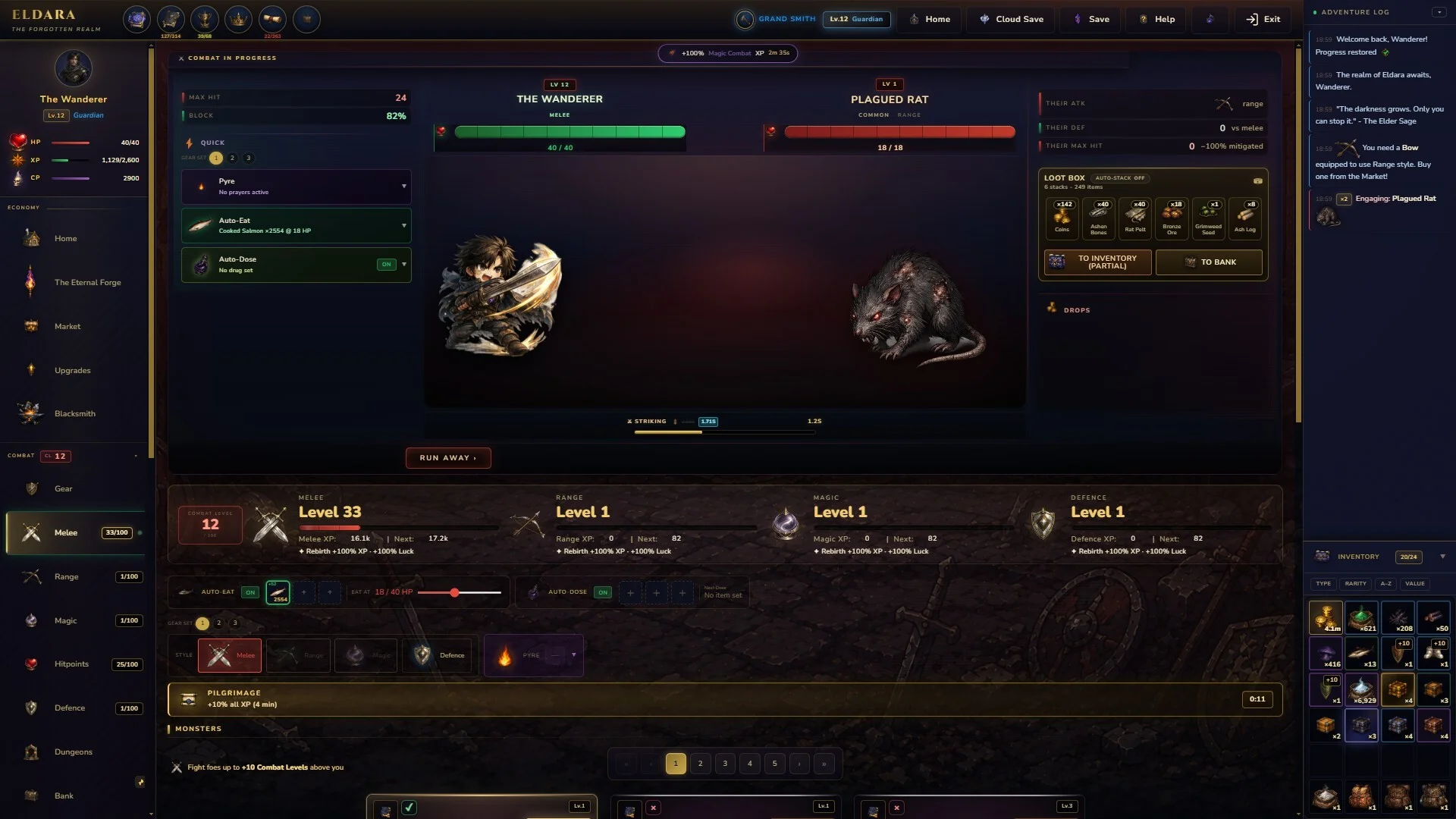
- Eldara level guide: Plan your progression around major XP milestones instead of chasing every level equally.
- Best early route: Prioritize Firemaking, Smithing, Cooking, Woodcutting, and Fishing for strong account-wide value.
- Combat advice: Upgrade gear at the Blacksmith when enhancement costs beat replacing an entire equipment tier.
- Gold strategy: Sell Elder Logs early, then add Hunting Contracts as your Hunting level improves.
- Rebirth planning: Finish achievements, pets, trophies, and Mythic gear before committing to the reset.
Eldara level guide: XP milestones from 1 to 100
This Eldara level guide uses the available community XP reference to show how sharply the later levels scale. The early game is comparatively forgiving, while the final stretch requires a deliberate plan for passive bonuses, consumables, and efficient activities. XP values below apply to skills and combat levels in the cited progression reference. Crafting and Smithing include several higher XP checkpoints at unusual levels.
| Level | Required XP | Planning note |
|---|---|---|
| 1 | 0 XP | Starting point |
| 5 | 382 XP | Early unlock range |
| 10 | 1,112 XP | Basic progression |
| 15 | 2,273 XP | Establish your core route |
| 20 | 4.2k XP | Crafting level 22 is 5.2k |
| 25 | 7k XP | Begin specializing |
| 30 | 11.7k XP | Perks become more valuable |
| 35 | 19k XP | Crafting level 38 is 25.3k |
| 40 | 30.6k XP | First major efficiency target |
| 45 | 50k XP | Prepare for stronger passives |
| 50 | 78.2k XP | Crafting level 52 is 94.146k |
The most useful early target is often the range between level 40 and level 70. The reference describes this bracket as a strong “sweet spot” because several perks become available without requiring the enormous XP investment associated with the final levels. Reaching useful level 70 perks can therefore improve the rest of the grind rather than merely increase a number.
| Level | Required XP | Planning note |
|---|---|---|
| 55 | 124.5k XP | Keep improving production loops |
| 60 | 197.9k XP | Passive bonuses matter more |
| 65 | 314.5k XP | Crafting level 67 is 379k |
| 70 | 500k XP | Important perk milestone |
| 75 | 794k XP | Transition toward long-term farming |
| 80 | 1.260m XP | Crafting level 82 is 1.515m |
| 85 | 1.999m XP | Efficiency becomes essential |
| 90 | 3.173m XP | Crafting level 92 is 3.818m |
| 95 | 5.037m XP | Final-half grind begins |
| 100 | 7.996m XP | Maximum listed level checkpoint |
From level 91 onward, each step becomes increasingly expensive. The listed checkpoints rise from 3.481m XP at level 91 to 7.996m XP at level 100. Treat this final section as a long-term project. Boosting XP gain, activity speed, and survivability before pushing the last ten levels can save considerable time.
Aim for useful perk breakpoints first. A level 70 upgrade that improves future speed or XP gain can be more valuable than rushing directly toward level 100.
Best skill order for efficient progression
Eldara’s skills support one another, so the strongest leveling route is not simply the skill with the highest visible XP rate. Firemaking is recommended as an early priority because its perks and passives can improve later grinding. Smithing expands tool access and equipment options, while Cooking and Fishing help maintain reliable healing.
Firemaking
- Primary XP priority
- Unlocks useful XP perks and passives
- Elder Logs can support early gold farming
Smithing
- Utility priority
- Improves access to tools and market options
- Helps maintain practical gear upgrades
Cooking and Fishing
- Survival priority
- Provides stronger healing options
- Makes difficult combat and dungeon sessions easier
Woodcutting, Fishing, and Smithing naturally fit into the early progression route. Cremating and Cultivation can be added later because the reference describes them as relatively fast when supported by Hunt Store and general upgrades. Bones from Woodcutting can help support Cremating, while seeds from the market can reduce downtime for Cultivation.
| Skill | Main value | Recommended timing |
|---|---|---|
| Firemaking | XP perks, passives, Elder Log income | Start early |
| Smithing | Tools, equipment, Blacksmith support | Start early |
| Cooking | Stronger healing and HP sustain | Start early |
| Fishing | Food supply and healing support | Pair with Cooking |
| Woodcutting | Elder Logs, bones, dependable gold | Use whenever funds are low |
| Hunting | Gold, materials, contracts, store perks | Scale into mid and late game |
| Cremating | Fast secondary progression | Add after core upgrades |
| Cultivation | Resource production | Add when seeds are available |
The reference estimates that the full skill and combat progression represents roughly 135 million total experience. That figure changes how you should evaluate upgrades: a bonus that multiplies XP or activity speed can remain useful across a very large number of actions. Passive improvements are especially valuable during long online or offline sessions.
Build around Firemaking, Smithing, and Cooking first. Add Woodcutting and Fishing naturally, then use Hunting to strengthen income, materials, and store-based bonuses.
Step-by-step leveling route
Use this route when starting a fresh progression cycle or rebuilding after a reset. It focuses on account stability before expensive late-game goals.
Create a stable resource base
Begin with Woodcutting, Firemaking, Fishing, Cooking, and Smithing. Keep a reliable supply of healing food, gather materials while leveling, and avoid spending every coin on immediate gear upgrades.
Push toward the level 40 to 70 bracket
Treat level 40 as the first meaningful checkpoint, then work toward level 70 perks. This range offers a practical balance between attainable XP costs and stronger progression bonuses.
Unlock stronger Hunting support
Invest in Hunting as your account develops. Hunting Contracts can provide gold, equipment, bread, and materials, while Hunt Store perks can improve the value of later activities.
Convert spare resources into progression
Use money for XP-enhancing buffs, passive upgrades, consumables, crates, and useful market purchases. Bread can reduce the time needed to maintain healing during extended sessions.
Prepare for the final levels
Before pushing from level 90 to 100, stock food and consumables, improve gear, use available XP bonuses, and choose activities that remain efficient for long sessions.
A practical account should maintain several parallel goals rather than leveling only one skill. For example, Woodcutting can solve short-term gold problems while Cooking and Fishing protect combat uptime. Smithing can reduce equipment friction, and Firemaking can improve the efficiency of every later grind.
| Progression phase | Main objective | Supporting activities |
|---|---|---|
| Early game | Build income and healing | Woodcutting, Firemaking, Fishing, Cooking |
| Mid game | Reach useful perk breakpoints | Smithing, Hunting, skill contracts |
| Late game | Improve XP and clear speed | Buffs, consumables, dungeons, upgraded gear |
| Pre-rebirth | Finish account requirements | Achievements, pets, trophies, Mythic gear |
Do not judge progress only by the level of one skill. A slightly lower combat level with better food, tools, passives, and income can produce faster overall advancement.
Combat, gear, and dungeon preparation
Combat progression depends on more than replacing equipment with the next named tier. Enhancement levels, passive effects, shiny gear, monster gear, guild bonuses, and healing supplies all affect the outcome. If gold is limited, compare the cost of improving current gear against buying a completely new set.
The source reference gives a useful example: bronze gear at +10 can outperform ruby gear at +0 in raw stats, although perks and passives still need to be considered separately. This makes the Blacksmith an important part of progression, especially when a new tier is expensive or provides only a modest practical improvement.
Blacksmith Upgrades
- Improve affordable gear before replacing it
- Compare enhancement cost with next-tier cost
- Avoid leaving important equipment at +0
Shiny Equipment
- Each shiny item provides +25% extra attack and defense stats
- Two strong shiny pieces can exceed a later normal tier
- Prioritize useful pieces rather than chasing every drop
Monster Gear
- Helm, armor, legs, and boots can each add perks
- Weapons, rings, and amulets expand passive coverage
- Combine pieces when their special effects fit your build
Guilds can also support combat. The reference lists three swapable combat-focused guild choices:
| Guild | Combat bonus | Best use |
|---|---|---|
| Ashen Legion | Damage percentage | Faster kills |
| Verdant Circle | HP percentage | Greater survivability |
| Guilded Hammer | Defense percentage | Safer difficult encounters |
Guild selection can be changed when your current objective changes, and the percentage depends on reputation. Choose damage for comfortable farming, HP when healing pressure is high, and defense when incoming hits are the main problem.
For difficult fights, prepare food and other consumables before starting. Bread is described as a practical long-session option because its healing can improve substantially, and Auto-eat can consume multiple units when necessary. Dungeons may also be preferable for overnight progression when you have enough food, drugs, and salts, because they can combine equipment drops with contract-related income.
When you struggle, visit the Blacksmith before abandoning an entire equipment set. Enhancement levels can make inexpensive gear competitive with a higher, unenhanced tier.
Gold farming, offline progress, and supplies
Gold is a progression tool rather than an end goal. Early accounts can use Woodcutting and Elder Logs to build a dependable reserve, while Hunting Contracts become more attractive as Hunting levels and contract rewards improve. Thieving may also produce useful overnight income, but its value can vary by mode and personal progression.
Keep enough money available for food, upgrades, market materials, and emergency gear improvements. The reference suggests maintaining about 1 million gold as a general reserve. Treat that as a practical buffer rather than a mandatory requirement, especially if your current activity has different costs.
| Method | Main reward | When to use it |
|---|---|---|
| Woodcutting | Elder Logs and side materials | Early income and emergency funds |
| Hunting Contracts | Gold, bread, equipment, materials | Mid and late progression |
| Thieving | Gold during unattended sessions | Early or overnight experimentation |
| Crates | Materials and possible pet drops | Spend spare gold during progression |
| Market purchases | Seeds, bread, useful supplies | Reduce repetitive gathering time |
Crates are worth considering because they can provide materials and pet-drop opportunities. Their contents may scale with combat level, while some material requirements remain consistent. The reference also notes that Wanderer Crates can provide Emerald gear around combat levels 90–100, making them more relevant during late progression.
Bread can be an efficient purchase when the alternative is spending days gathering low-level food. The healing amount begins modestly and can increase substantially, making it useful for extended dungeon or boss preparation. Always balance convenience purchases against your need for tools, gear, buffs, and permanent upgrades.
The Codex should be part of every progression loop. It exposes information about skills, fights, and unlocks before you reach them, allowing you to plan materials and avoid unnecessary experimentation. Backpacks also provide passive buffs, so review their bonuses instead of treating them as simple storage upgrades.
Use spare gold on XP bonuses, permanent upgrades, healing supplies, crates, and materials that remove bottlenecks. Hoarding becomes less valuable once your core progression is secure.
Rebirth requirements and final checklist
Rebirth is a major reset, not a routine level milestone. The available reference states that you must finish nearly all major completion requirements before rebirthing, including achievements, pets, world-boss trophies, and Mythic gear. Guild progress, Hunt Store upgrades, and general skill upgrades are retained, but Hunt Store points are lost.
You lose tools, gear, money, and the contents of your bank and inventory. Pets remain available after the reset, which makes pet progress especially important before committing. A first completion cycle can take approximately three weeks, depending on mode, activity choices, and how efficiently your account prepares for the final requirements.
| Rebirth category | Required or affected status |
|---|---|
| Achievements | Must be completed according to the reference |
| Pets | Required; pets are retained after rebirth |
| World-boss trophies | Must be completed |
| Mythic gear | Must be completed |
| Guild progress | Retained |
| Hunt Store upgrades | Retained |
| Hunt Store points | Lost |
| Tools, gear, money, bank, inventory | Lost |
Prestige also matters for long-term combat planning. Prestige level 10 is associated with 2,200 Monster or Dungeon clears in the reference. Repeated dungeon clears can count toward multiple monster totals, so choose content that advances several objectives at the same time.
Pre-Rebirth Checklist:
- Reach the desired skill and combat milestones
- Complete all required achievements
- Collect pets and world-boss trophies
- Finish the required Mythic gear objectives
- Spend or secure resources before tools, gear, money, bank, and inventory are reset
Before rebirthing, use the Codex to confirm requirements and inspect every unfinished achievement. Finish practical upgrades first, then convert excess money into consumables, buffs, or other progress that will not be wasted by the reset. Do not spend Hunt Store points too early if you still need a specific permanent upgrade.
Rebirth removes most inventory and progression resources. Verify every requirement in the Codex and complete your final preparation before selecting the reset.
For reference, consult the player-maintained Level 1–100 XP and tips discussion on Steam. It contains the listed XP checkpoints, skill recommendations, gear observations, combat bonuses, and rebirth notes used in this guide.
Q: What is the most important target in the Eldara level guide?
The level 40 to 70 range is the most practical early target because it offers meaningful perks without the extreme XP costs of the final levels. Reaching useful level 70 bonuses can improve the rest of your progression.
Q: Which skills should I prioritize first?
Start with Firemaking for XP perks and passives, Smithing for tools and equipment support, and Cooking for stronger healing. Woodcutting and Fishing naturally support income and food production.
Q: What should I do when my combat gear feels too weak?
Check the Blacksmith before replacing the full set. Enhanced lower-tier gear can outperform unenhanced higher-tier gear in raw stats, although perks and passives must still be compared.
Q: What do I keep after rebirth?
Pets, guild progress, Hunt Store upgrades, and general skill upgrades are retained according to the reference. Tools, gear, money, bank contents, and inventory contents are lost, while Hunt Store points are also spent or removed.