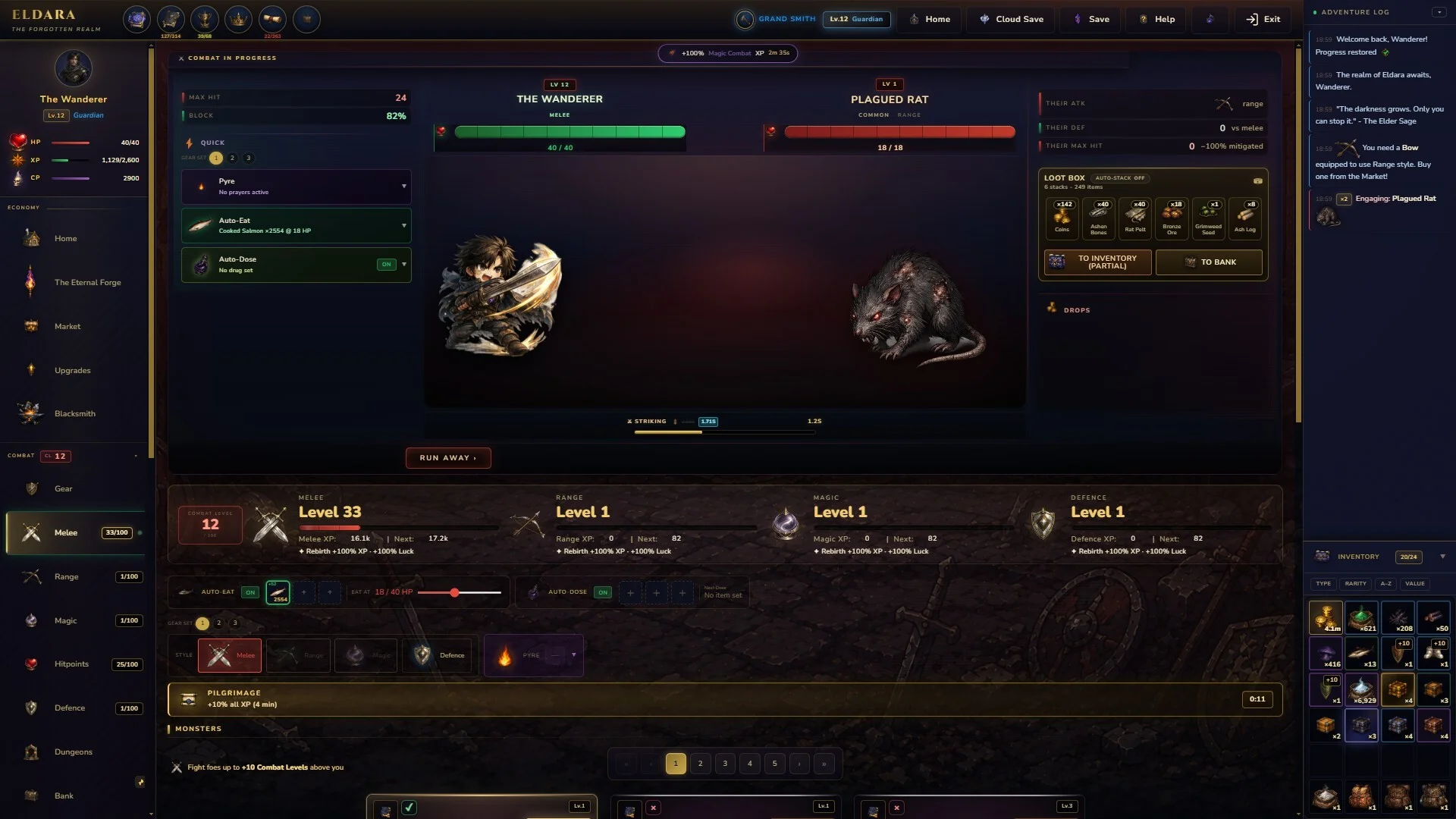
- Eldara item guide: Use loot, crafting, weapons, and gear categories to organize upgrades.
- Best gear focus: Compare equipment by spec, set bonuses, and your preferred combat range.
- Forge planning: Treat Eternal Forge upgrades as a deliberate resource decision.
- Upgrade order: Secure a functional loadout before chasing specialized or higher-investment pieces.
- Reference hub: Browse the Eldara Steam Guides for community-created updates.
Eldara Item Guide: How to Read the Loot Pool
This Eldara item guide is designed around the item-related categories currently available through the official Steam community guide hub. The most useful filters for equipment planning are Loot, Crafting, Weapons, Gameplay Basics, and Walkthroughs. These categories help separate acquisition advice from build advice, which makes it easier to decide whether an item should be equipped, crafted, saved, or replaced.
The current guide index also highlights gear by combat specialization, including melee, ranged, and magic approaches. That distinction matters because the strongest-looking item is not automatically the best choice for every loadout. Start by identifying your active spec, then compare the item’s role, set contribution, and upgrade cost.
| Item Question | Recommended Check | Why It Matters |
|---|---|---|
| What is the item for? | Damage, defense, utility, or progression | Prevents upgrades that do not support your current build |
| Which spec uses it? | Melee, ranged, or magic | Keeps equipment aligned with your combat style |
| Does it belong to a set? | Check visible set bonuses | A lower individual stat may support stronger combined results |
| Can it be upgraded? | Review forge or crafting options | Helps avoid spending resources on temporary gear |
| Is it replaceable? | Compare against likely next upgrades | Protects scarce materials and currency |
Loot
Use this category to locate community advice about item acquisition, drop priorities, and equipment targets.
Crafting
Use crafting references when raw materials, recipes, or upgrade choices become more important than immediate drops.
Weapons
Review weapon-focused guidance when your damage pattern, attack range, or spec needs to change.
Do not judge an item from its name alone. First identify its combat role, then check whether its set bonus or upgrade path supports your current specialization.
Best Gear Priorities by Combat Spec
The most practical way to organize Eldara equipment is to begin with the role your character already performs. Community gear guidance separates equipment by melee, ranged, and magic specifications, making those three paths useful starting points for comparisons. Instead of searching for one universal best item, build a shortlist for each spec and remove pieces that do not match your preferred range or damage pattern.
A strong loadout usually has a clear purpose. Melee equipment should support close-range pressure and survivability. Ranged equipment should preserve spacing while maintaining consistent damage. Magic equipment should be judged by how well it supports spell-focused play and the set bonuses available to that setup.
| Combat Spec | Primary Evaluation | Common Mistake | Better Approach |
|---|---|---|---|
| Melee | Durability, close-range damage, reliable uptime | Choosing damage without enough survivability | Balance offense with the ability to remain in range |
| Ranged | Range control, consistent damage, safe positioning | Overvaluing burst while ignoring accuracy or uptime | Favor equipment that supports repeated attacks |
| Magic | Spell performance, resource management, set synergy | Mixing pieces without checking specialization benefits | Build around a coherent magic-focused setup |
| Hybrid | Flexibility and transition value | Investing equally in incompatible item paths | Choose one primary spec and use hybrid pieces selectively |
How to Compare Two Similar Items
When two items appear close in power, compare them in this order:
- Spec alignment: Keep the piece that supports the way you actually deal damage.
- Set value: Check whether either item activates or improves a useful set bonus.
- Upgrade lifespan: Prefer the item that can remain relevant through more progression stages.
- Resource cost: Delay expensive improvements if a replacement is likely soon.
- Practical performance: Select the item that performs consistently in your usual encounters.
The Steam community guide index includes a featured reference titled Best Gear, which organizes equipment recommendations by melee, ranged, and magic specifications. Use that reference as a comparison aid, then confirm that each recommendation still matches your own progression stage and available resources.
A higher individual number does not always represent a stronger loadout. Replacing a set piece can reduce the value of the rest of your equipment, so compare the full setup before confirming an upgrade.
Loot, Crafting, and Eternal Forge Workflow
A reliable item route should move through three decisions: collect, evaluate, and invest. Collect useful drops and materials without immediately spending everything. Evaluate each item against your active spec and current set. Invest only after you know the piece has a meaningful role in your next progression phase.
The available Eldara guide categories support this workflow. Loot helps identify acquisition targets, Crafting supports material and recipe decisions, and the featured Eternal Forge guide provides a quality-of-life method for holding the left mouse button automatically through Windows’ built-in input behavior. That utility can reduce repetitive input during suitable tasks, but it does not replace careful item evaluation.
| Phase | Main Action | Decision Standard |
|---|---|---|
| Collect | Gather drops and crafting materials | Keep items that support your active or planned spec |
| Sort | Separate usable gear from temporary pieces | Compare role, set value, and upgrade potential |
| Equip | Build a functional loadout | Prioritize consistency over isolated high numbers |
| Craft | Spend materials on meaningful improvements | Upgrade pieces with a reasonable expected lifespan |
| Forge | Apply higher-investment improvements | Confirm the item fits your long-term setup first |
Define Your Active Spec
Choose melee, ranged, magic, or a clearly defined hybrid direction before sorting your inventory. This gives every later item decision a consistent baseline.
Create a Keep List
Mark equipment that matches your spec, contributes to a useful set, or offers a practical upgrade over your current piece. Separate uncertain items instead of discarding them immediately.
Check Crafting Requirements
Review the materials and recipes needed for the next improvement. If the cost is high and the item is temporary, save those resources for a better target.
Test the Full Loadout
Equip the proposed set and assess damage, survivability, positioning, and resource pressure. A balanced setup is often more useful than a narrow damage increase.
Commit Forge Resources
Use Eternal Forge investment only after the item passes your spec, set, and lifespan checks. This keeps expensive improvements focused on dependable gear.
The Eternal Forge reference is available through the Eldara Steam Guides page. Its focus is input convenience rather than item strength, so keep automation-related advice separate from decisions about loot quality, crafting value, or build optimization.
The safest upgrade target is a piece that improves your current setup, supports a useful set bonus, and is unlikely to be replaced immediately.
Inventory Setup and Upgrade Planning
Inventory organization becomes more valuable as your collection grows. Use simple groups such as Current, Next Upgrade, Crafting Materials, and Spec Swap. This prevents valuable equipment from being mistaken for disposable loot and makes it easier to switch between melee, ranged, and magic setups when needed.
A small planning table can also reduce unnecessary spending. Record the item’s purpose, its current status, and the condition that would justify an upgrade. This approach is especially useful when several pieces compete for the same crafting or forge resources.
| Inventory Group | Store Here | Action |
|---|---|---|
| Current | Equipment used in your active build | Maintain and improve when the cost is reasonable |
| Next Upgrade | Stronger pieces awaiting materials or testing | Compare against your full set before equipping |
| Crafting Materials | Resources reserved for recipes or upgrades | Do not spend without a defined target |
| Spec Swap | Gear for melee, ranged, or magic alternatives | Keep only pieces with a clear secondary purpose |
| Review Later | Items with uncertain value | Recheck after learning more about your build |
Keep
Preserve gear that matches your active spec, supports a useful set, or fills a role your loadout currently lacks.
Compare
Test similar pieces by full-set performance rather than looking at one isolated value.
Delay
Postpone costly crafting or forge work when the item may be replaced during the next progression step.
Practical Upgrade Rules
- Upgrade the piece that fixes your largest current weakness.
- Avoid rebuilding the entire loadout when one replacement solves the problem.
- Keep a secondary setup only when it has a clear combat or progression purpose.
- Recheck set bonuses after every major equipment change.
- Reserve rare materials for items that can remain useful across multiple stages.
- Treat quality-of-life tools as separate from power upgrades.
Item Planning Checklist:
- Identify the active combat specialization
- Sort gear into current, next upgrade, and spec swap groups
- Compare full-set value before replacing a piece
- Reserve crafting materials for a defined target
- Confirm an item is worth long-term forge investment
Your inventory should answer three questions quickly: what you use now, what you want next, and which materials are already reserved.
Eldara Item Guide FAQ
Use the following answers as a compact reference when planning your next equipment route. The recommendations focus on the verified guide categories and the gear-planning principles supported by the Eldara Steam community hub.
Q: What should I check first in an Eldara item guide?
Start with the Loot, Crafting, Weapons, and Gameplay Basics categories. Then identify whether the recommendation is intended for melee, ranged, or magic play.
Q: Is the highest individual item value always the best upgrade?
No. Compare the item’s combat role, set bonus, upgrade cost, and likely lifespan. A slightly weaker piece may produce a better full-loadout result.
Q: How should I divide gear between melee, ranged, and magic setups?
Choose one primary specialization for most investments. Keep alternative pieces only when they provide a clear secondary setup or help you transition between combat styles.
Q: When should I use Eternal Forge investment?
Use it after confirming that the item matches your active spec, contributes to a useful setup, and is unlikely to be replaced soon. Quality-of-life input guidance should not be confused with power progression.
The Eldara Steam Guides hub remains the best place to review community-created references for loot, crafting, weapons, walkthroughs, and other categories. Recheck the index before making major equipment decisions so your route reflects the latest available community guidance as of September 4, 2026.
Build around one clear spec, compare complete sets, and spend crafting or forge resources only when the upgrade has a defined purpose.