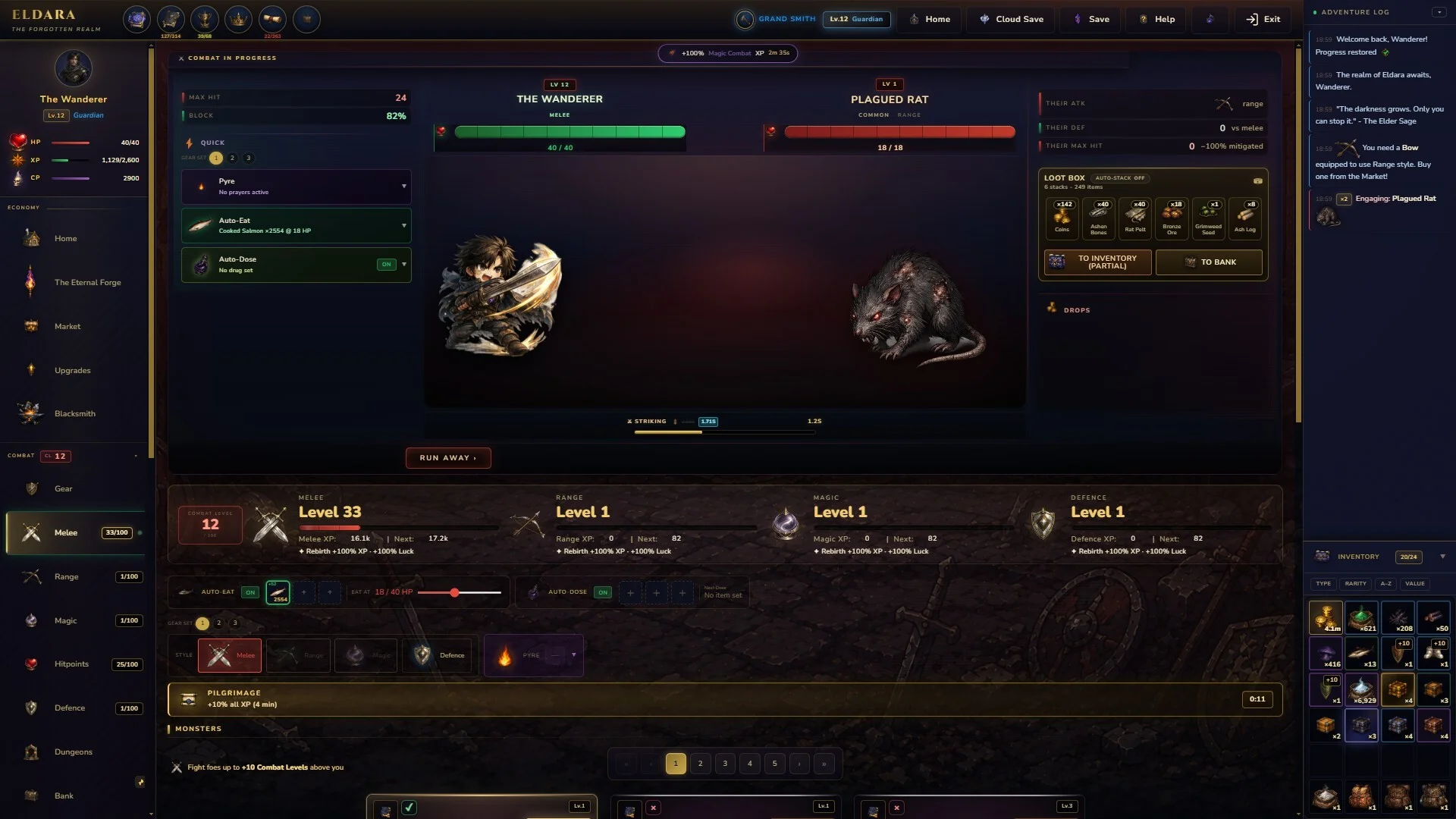
- Eldara emerald leather should be treated as a progression material until its exact source is confirmed in-game.
- Check the item tooltip first for source, recipe, station, or activity requirements.
- Test one activity at a time and record results before committing valuable resources.
- Prioritize targeted production over random crafting when the material appears in a higher-tier recipe.
- Use the community discussion to compare observations without treating casual comments as drop-rate data.
Eldara emerald leather: What to Confirm First
The first step for Eldara emerald leather is identifying whether it comes from harvesting, processing, crafting, or a specific activity reward. The currently available community discussion establishes that Eldara includes several distinct activities, including cultivating, thieving, and firemaking, but it does not confirm a precise emerald leather acquisition route or drop rate.
That means a reliable farming plan should begin with the item interface rather than assumptions based on the material’s name. Emerald leather may be connected to a recipe chain, a processing station, a profession milestone, or an activity-specific reward. Confirm the item’s classification before spending time on broad farming tests.
| Checkpoint | What to inspect | Why it matters |
|---|---|---|
| Item tooltip | Source text, recipe, station, tags | Reveals whether the material is gathered or produced |
| Recipe panel | Required inputs and output quantity | Shows whether emerald leather is an intermediate material |
| Activity screen | Reward preview, progress bar, skill requirement | Helps identify activity-linked materials |
| Inventory filter | Leather, refined, rare, or quest categories | Prevents overlooking a stored material |
| Upgrade menu | Unlock level, building, or research requirement | Indicates whether access is progression-gated |
Do not assume that “emerald” means a gemstone-based ingredient. In Eldara, confirm whether the item belongs to a leather tier, a refined-material category, or a special upgrade chain.
Gathering Route
Look for activities that directly place hides, leather, or rare materials into the inventory. Confirm the output in the reward panel before repeating the activity.
Processing Route
Check whether ordinary leather can be refined through a station or recipe. Record the required inputs and the resulting quantity.
Progression Route
Inspect skill milestones, unlock screens, and special rewards. Some materials may appear only after a system becomes available.
The safest interpretation of the available evidence is that Eldara has activity-based progression and resource management, but the exact emerald leather route must be confirmed through the item and recipe interfaces. Treat player reports as leads, not as guaranteed mechanics.
How to Find the Emerald Leather Source
Use a controlled search instead of switching randomly between every Eldara activity. A controlled search makes it easier to identify whether the item is generated by an action, awarded after a milestone, or created by combining lower-tier materials.
Open Every Relevant Item Panel
Search the inventory, crafting menu, storage interface, and upgrade screens for “emerald leather.” Open the full tooltip and note every displayed requirement, source label, and unlock condition.
Separate Direct Drops From Recipes
If the item appears in a reward preview, test the related activity once and record the result. If it appears as a recipe output, identify the station and required ingredients before attempting production.
Check Activity Requirements
Review cultivating, thieving, firemaking, and any other unlocked activity screens for reward changes, skill thresholds, or special task conditions. Do not rely on the activity name alone.
Run a Small Sample
Perform a limited number of actions under the same conditions. Record action count, time spent, input cost, and output. This distinguishes a repeatable route from a one-time reward.
Verify Before Scaling Up
Once a source appears reliable, repeat it with a larger sample. Stop if the result changes after a requirement, screen, or activity condition changes.
| Investigation stage | Record | Good stopping point |
|---|---|---|
| Interface check | Tooltip wording and unlock text | A source or recipe is clearly displayed |
| First test | Activity, inputs, action count, output | One result confirms the suspected route |
| Repeat test | Results across several attempts | Output remains consistent |
| Cost review | Time, materials, upgrades, inventory space | Route is practical for the current progression |
| Final confirmation | Recipe or reward panel screenshot | The route can be repeated without guesswork |
A single emerald leather appearance does not prove a permanent drop rate. Special tasks, milestones, activity states, and first-time rewards can produce results that do not repeat.
When testing, keep the activity screen visible when possible. Eldara’s community discussion indicates that different screens can produce noticeably different system behavior, so changing screens during a test can also make comparisons less consistent. This is useful both for performance tracking and for resource testing.
Efficient Farming and Material Management
After confirming a legitimate source, optimize the route around output per action rather than choosing the most visually obvious activity. An efficient emerald leather method should minimize unnecessary inputs, idle time, and inventory interruptions.
| Farming factor | Preferred condition | Why it improves the route |
|---|---|---|
| Output | Predictable material yield | Makes planning and inventory targets easier |
| Input cost | Common or renewable materials | Reduces pressure on limited resources |
| Action speed | Short, repeatable cycles | Improves progress during active play |
| Unlock cost | Already available station or activity | Avoids delaying other upgrades |
| Inventory demand | Compact output chain | Reduces interruptions and storage management |
A useful comparison method is to measure three values:
- Material per action: how much emerald leather is produced by one completed action.
- Material per input: how efficiently ordinary leather or other ingredients are converted.
- Material per minute: how much the route produces during a consistent test period.
Do not compare a direct reward and a crafted output using only their final quantities. A recipe may produce more emerald leather but require several lower-tier ingredients, extra station time, or a costly unlock. Conversely, a slow activity may become worthwhile when it uses no consumable input.
Once a source remains consistent across repeated tests, set a storage target and farm only until that target is reached. This prevents overproducing a rare material before its next use is known.
Low-Cost Strategy
Use the route with the fewest scarce inputs. This is usually best when emerald leather is needed for an early upgrade or trial recipe.
Active Strategy
Choose the shortest repeatable action when you are actively monitoring progress and can handle frequent inventory checks.
Background Strategy
Favor stable, low-maintenance production when Eldara is running while you are doing something else. Review heat and system load regularly.
The performance discussion around Eldara reports that resource use and temperatures can vary by screen or skill. Because of that, longer farming sessions should include practical system checks. Lowering unnecessary visual load, minimizing the window when appropriate, and using a frame limit if the game provides one can make extended sessions more comfortable.
| Session type | Recommended approach | Management priority |
|---|---|---|
| Short test | Compare one route for a limited sample | Accuracy |
| Active farming | Monitor output and inventory frequently | Yield per minute |
| Background farming | Use a stable, low-interaction activity | System load and reliability |
| Large stockpile | Set a target before starting | Storage efficiency |
Common Mistakes With Emerald Leather
Rare crafting materials are easy to mismanage when their source is unclear. The most common mistake is treating a community guess as a confirmed mechanic. A better approach is to separate verified interface information, repeatable observations, and speculation.
| Mistake | Result | Better practice |
|---|---|---|
| Farming every activity at once | No clear source comparison | Test activities separately |
| Spending rare inputs immediately | Materials disappear before the recipe is understood | Inspect the full recipe first |
| Trusting one lucky result | Temporary reward looks repeatable | Repeat under identical conditions |
| Ignoring unlock text | A gated source is mistaken for a bug | Check skill and station requirements |
| Running indefinite sessions | Heat, crashes, or wasted time become more likely | Use timed sessions and review performance |
Keep a reserve of lower-tier leather and related inputs until the emerald leather recipe is fully understood. Converting everything at once can block other upgrades or experiments.
Use the following checklist before committing to a large farming session:
Emerald Leather Farming Checklist:
- Read the complete emerald leather tooltip and note every requirement
- Confirm whether the material is gathered directly or produced by a recipe
- Test one activity or station without changing conditions
- Record output, inputs, action count, and approximate session time
- Reserve enough lower-tier materials for other known upgrades
If the item does not appear in any visible source panel, avoid declaring it unobtainable. It may be linked to an unreached progression milestone, a special task, or a system that is not yet unlocked on the current character. Recheck after advancing the relevant skill, station, or activity.
For community comparison, use the Eldara Steam discussion hub. Search for emerald leather, ruby leather, and other related material terms, then compare multiple observations rather than copying an isolated claim.
Planning Your Next Eldara Upgrade
The value of emerald leather depends on what you plan to build, craft, or unlock next. Before farming, identify the immediate goal and calculate a reasonable stockpile. This keeps the route focused and prevents rare materials from sitting unused.
| Goal | Planning question | Suggested preparation |
|---|---|---|
| First recipe test | What other ingredients are required? | Gather the complete recipe once |
| Equipment upgrade | Is the material consumed on failure or success? | Keep a reserve before crafting |
| Station unlock | Does the station create multiple leather tiers? | Check future recipes before investing |
| Skill progression | Does the activity improve another resource? | Compare total progress, not one item |
| Long-term stockpile | When will the material be needed again? | Set a capped storage target |
A practical planning cycle looks like this:
- Identify the next confirmed use for emerald leather.
- Gather the required amount plus a small reserve.
- Complete the recipe or upgrade once.
- Recheck whether the item gains another use at the next progression tier.
- Resume farming only when a confirmed requirement exists.
This approach is especially useful for materials with tiered names. Emerald leather and ruby leather may appear related, but their sources, recipes, or unlock conditions should not be assumed to match. Verify each item independently.
Record the date, activity name, station level, and result whenever you discover a route. Use the 2026 date on your notes so later balance or progression changes are easier to identify.
Q: How do I acquire Eldara emerald leather?
Start by checking the item tooltip, crafting menu, reward panels, and unlock screens. The available evidence does not establish a confirmed universal route, so verify whether it is a direct reward, processed material, or progression-gated recipe before farming.
Q: Can I assume emerald leather comes from the same source as ruby leather?
No. Similar naming suggests a related material tier, but it does not prove identical sources or requirements. Inspect and test each material separately.
Q: Which Eldara activity should I farm first?
Choose the activity that visibly lists emerald leather or its required precursor. If no source is displayed, test activities one at a time and compare output, input cost, and action time.
Q: Should I farm emerald leather while Eldara runs in the background?
Only after confirming a stable route and checking system behavior. Community reports indicate that resource use can vary by screen or skill, so use timed sessions and monitor temperature, load, and stability.
Treat emerald leather as a verification-first material. Confirm the route, measure a small sample, protect your reserves, and scale only after the result is repeatable.
Emerald Leather Route Summary
The strongest method for handling Eldara emerald leather is not to guess from the item name. Inspect every relevant interface, distinguish direct rewards from crafted outputs, test a single route under consistent conditions, and record the result. Once the source is repeatable, optimize for material per action, material per input, and material per minute.
| Priority | Action | Expected benefit |
|---|---|---|
| 1 | Confirm the tooltip and source panel | Removes basic route errors |
| 2 | Identify the activity or station | Focuses testing |
| 3 | Run a controlled sample | Separates repeatable output from luck |
| 4 | Compare cost and time | Finds the practical farming method |
| 5 | Set a storage target | Prevents unnecessary overfarming |
Use the route that fits your current progression rather than chasing the highest theoretical output. A low-cost source may be better for early upgrades, while a faster recipe may become useful after the required station and inputs are available.
You are ready for a longer emerald leather session when the source is visible, the requirements are known, and repeated tests produce consistent results.