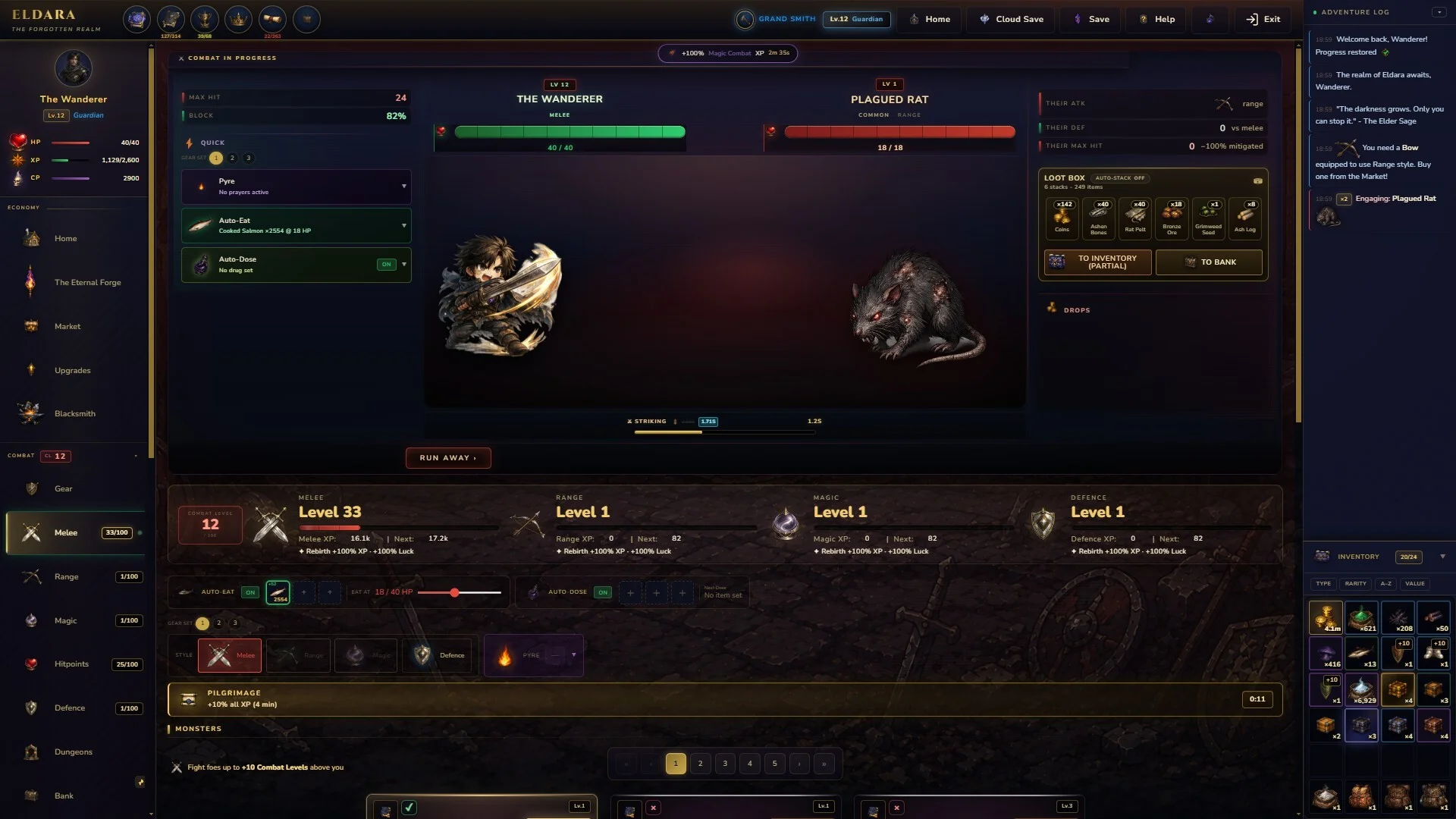
- Eldara story belongs to an RPG developed by Eldara Games
- Confirmed presentation includes English interface support and English subtitles
- Story tracking works best when you separate confirmed details from player interpretation
- Progression clues should be recorded through quests, characters, locations, and item descriptions
- Genre: SteamDB classifies Eldara as a role-playing game
Eldara Story: What Is Confirmed
The Eldara story currently has a clearly identified RPG framework, but its publicly verifiable profile does not provide a full plot synopsis, named cast, chapter list, or official lore archive. That makes a careful reading strategy more useful than guessing at hidden details.
Eldara is listed as a role-playing game developed by Eldara Games. The available platform information confirms English interface support and English subtitles. These details establish the basic identity of the project while leaving room for the in-game narrative to define its world, conflicts, and characters more fully.
For wiki readers, the most reliable approach is to treat confirmed metadata as the foundation and in-game discoveries as separate lore entries. Avoid presenting theories as established canon. A strong story page should tell readers which facts are verified, which details are directly observed, and which interpretations remain speculative.
| Confirmed element | Available detail | Editorial use |
|---|---|---|
| Developer | Eldara Games | Use in the game overview and infobox |
| Genre | RPG | Frame the article around role-playing and narrative progression |
| Interface language | English supported | Describe menu and text accessibility |
| Subtitle language | English supported | Mention for dialogue and story readability |
| Full audio | Not listed in the available record | Do not claim English voice acting |
| Story synopsis | Not provided in the available record | Avoid inventing plot details |
Record the exact wording of quest text, item descriptions, and character dialogue before adding interpretation. Small phrases often become important connections later.
How to Read the Available Information
The current profile supports several useful conclusions without overreaching:
- Eldara is positioned as an RPG rather than a standalone film, anime, or novel.
- Narrative information is likely to be experienced alongside role-playing progression, although specific quest systems are not confirmed here.
- English subtitles provide a documented way to follow written dialogue.
- The absence of a listed full-audio language does not prove that the game has no voice acting; it only means that this detail is not confirmed in the available record.
- A complete story summary should wait for direct evidence from the game or an official Eldara Games announcement.
The Eldara page on SteamDB identifies the application as an RPG, lists Eldara Games as developer, and provides the available language information.
Worldbuilding and Narrative Clues
A useful Eldara story guide should focus on how players can identify worldbuilding evidence. Until an official synopsis establishes the setting, avoid assigning names to regions, factions, gods, rulers, or historical events that have not been confirmed.
Instead, examine each narrative object through four questions:
- Who created or used it?
- What event does it describe?
- Where does it connect to the wider setting?
- Does another source support the same interpretation?
This method helps separate a direct statement from a theory. For example, an item description may mention a ruined settlement. That confirms the settlement existed in the item’s context, but it does not automatically confirm who destroyed it or when the event occurred.
| Lore evidence | What it can establish | What it cannot establish alone |
|---|---|---|
| Quest text | Objectives, named places, immediate conflict | The complete history of the world |
| Character dialogue | Personal motives, relationships, local rumors | Whether every rumor is factual |
| Item description | Object identity and possible history | The full origin of its creator |
| Environmental detail | Visual clues about location or past events | A definitive timeline without text support |
| Ending sequence | Major outcome of a story route | Every consequence beyond the shown scene |
Building a Reliable Story Timeline
Use a timeline with three confidence levels:
- Confirmed: Directly stated by a quest, character, item, or official announcement.
- Strongly supported: Suggested by multiple independent clues.
- Speculative: A reasonable theory that still needs confirmation.
This structure is especially valuable when documenting a new RPG. It allows the wiki to remain useful without turning uncertainty into misinformation. Readers can enjoy theories while still seeing where canon ends.
A compact timeline entry should include:
| Timeline field | Recommended entry |
|---|---|
| Event name | Short description using the game’s wording |
| Evidence | Quest, dialogue, item, location, or official post |
| Participants | Named characters or groups only |
| Location | Confirmed location name, if available |
| Confidence | Confirmed, supported, or speculative |
| Open questions | Details that still require evidence |
Do not label an interpretation as canon merely because it fits the setting. Mark theories clearly, especially when discussing endings, character motives, or unexplained historical events.
Story Categories Worth Tracking
Organize future entries into categories that match how RPG narratives are usually documented, while keeping each page evidence-based:
- Main plot: Major objectives and turning points.
- Characters: Background, relationships, dialogue, and personal goals.
- Locations: Geography, environmental clues, and historical importance.
- Factions: Alliances, rivalries, symbols, and stated beliefs.
- Items: Relics, tools, documents, and objects connected to the setting.
- Themes: Repeated ideas such as duty, identity, survival, memory, or conflict.
These categories make it easier to expand the wiki when more official and in-game material becomes available.
Step-by-Step Story Tracking Guide
The following process creates a dependable narrative record without requiring spoilers or unsupported assumptions. It also works well for players who want to understand the setting while progressing naturally.
Capture the First Narrative Hook
Write down the first named character, location, organization, or conflict you encounter. Preserve the original spelling and avoid summarizing it too aggressively. The first reference may later connect to a larger plot thread.
Separate Facts from Reactions
Create two notes: one for direct statements and one for personal interpretation. A character saying that an event happened is evidence; assuming why it happened belongs in the theory section.
Cross-Reference Repeated Terms
When a name, symbol, object, or place appears again, link the entries together. Repetition can reveal relationships, but confirm that the repeated term refers to the same subject before drawing conclusions.
Mark Progression Changes
Note when new dialogue, locations, objectives, or item descriptions become available. Record the trigger if it is clear, such as completing a quest or reaching a story milestone.
Review the Timeline Before Publishing
Compare every major claim with its evidence. Remove details that cannot be supported, move uncertain interpretations into a theory section, and identify unresolved questions for future updates.
The key principle is consistency. Use the same labels for evidence, confidence, and spoilers across every story page. This makes the wiki easier to navigate and helps readers understand how much trust to place in each conclusion.
| Tracking task | Best practice | Common mistake |
|---|---|---|
| Names | Copy official spelling | Normalizing names from memory |
| Events | Record the trigger and consequence | Listing events without sequence |
| Dialogue | Save the speaker and context | Quoting lines without attribution |
| Theories | Label speculation clearly | Presenting guesses as canon |
| Spoilers | Add a clear warning | Revealing major turns in summaries |
A short, well-sourced lore entry is more valuable than a dramatic summary filled with details that the game has not confirmed.
Recommended Story Note Format
Use a repeatable format for each entry:
- Subject: The character, place, object, or event.
- Summary: One or two sentences describing only confirmed information.
- Evidence: The exact quest, dialogue, item, or official source.
- Connections: Related entries already documented.
- Theory: Optional interpretation, clearly marked.
- Status: Confirmed, supported, or unresolved.
This format supports both casual readers and lore-focused players. It also keeps future updates manageable when new scenes, patches, or official announcements add context.
Story Research Checklist and Reference Standards
A good narrative article should be readable, cautious, and easy to update. Before publishing an Eldara story entry, check its wording against the available evidence and remove claims that rely only on genre expectations.
Canon
- Directly stated details
- Officially published information
- Clearly identified story outcomes
Characters
- Names and roles
- Stated motivations
- Confirmed relationships
World
- Locations and objects
- Factions and symbols
- Historical references
Theories
- Multiple supporting clues
- Explicit uncertainty
- Separate spoiler labeling
Story Research Checklist:
- Verify every named character, location, and faction
- Separate confirmed facts from theories
- Record the source or in-game evidence for major claims
- Add spoiler labels before discussing major plot developments
- Check language and audio claims against documented information
| Publication check | Pass condition |
|---|---|
| Accuracy | Every factual claim has direct support |
| Clarity | Canon and theory sections are separated |
| Spoiler control | Major reveals have visible warnings |
| Accessibility | Language details use documented wording |
| Maintenance | Unresolved questions are easy to update |
What This Guide Does Not Confirm
The available record does not establish:
- A named protagonist or playable character.
- A definitive setting, map, kingdom, planet, or historical era.
- A list of main quests or chapter titles.
- Specific factions, antagonists, companions, or romance paths.
- The existence of multiple endings or branching storylines.
- English voice acting or any other full-audio language.
- A complete official chronology.
Keeping these boundaries visible protects the wiki’s credibility. When confirmed details become available, they can be added without rewriting unsupported claims.
The current information does confirm that Eldara is an RPG by Eldara Games, with English interface and subtitle support. Those facts are enough to establish a reliable foundation while the story database grows.
Use official Eldara Games announcements first. For the currently documented RPG classification, developer, and language details, consult the SteamDB Eldara record.
Eldara Story FAQ
Q: What is the Eldara story about?
The available verified record identifies Eldara as an RPG developed by Eldara Games, but it does not provide a complete official plot synopsis, protagonist profile, or named setting. A reliable story summary should use direct in-game evidence or official announcements rather than invented lore.
Q: Is Eldara a role-playing game?
Yes. The SteamDB record identifies Eldara as an RPG. This supports describing it as a role-playing title, while specific mechanics, quests, combat systems, and progression features should only be documented when confirmed.
Q: What language support is confirmed for Eldara?
English interface support and English subtitles are listed in the available record. Full audio is not listed there, so voice-acting details should not be assumed without a separate official confirmation.
Q: How should players document Eldara lore?
Track named characters, locations, factions, items, and events separately. Quote or summarize direct evidence, mark theories as speculation, connect repeated terms, and review the timeline before publishing a story claim.
When new story details appear, update the evidence table first. Then revise summaries and theories so the distinction between fact and interpretation remains clear.