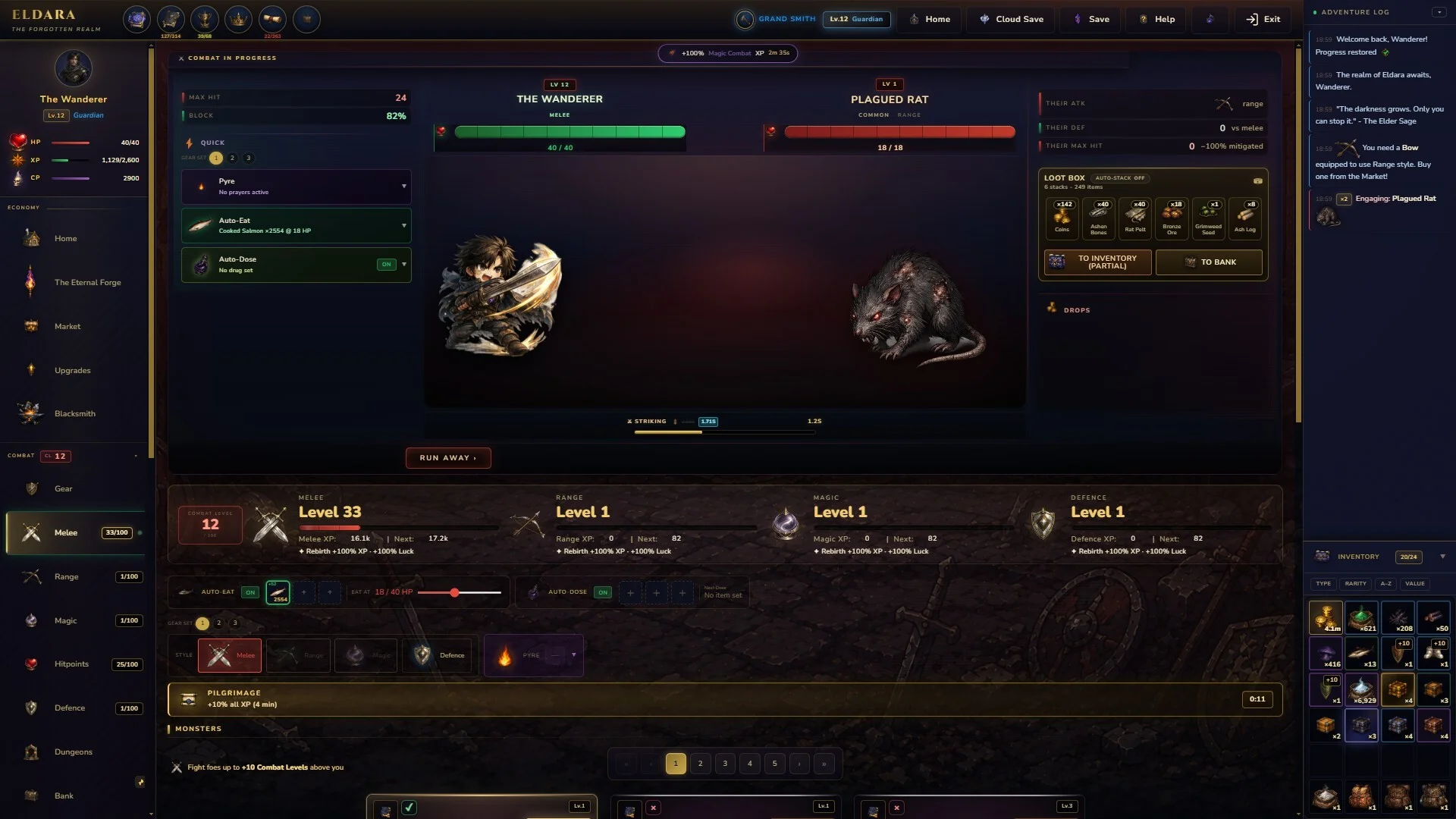
- Eldara fantasy world: A fractured realm shaped by ancient magic, ruined gods, and the Arcane Cataclysm.
- Core setting: Regions, city-states, elemental forces, planar secrets, and powerful pacts define daily life.
- Key location: Ironpeak is a storm-forged city where clans rule through blade, law, and arena honor.
- Major power: Asharakh is an obsidian city of chains governed by pactcraft and severe obligations.
- Timeline: Seven named eras track Eldara from its origins through catastrophe, recovery, silence, and the current age.
Eldara fantasy world at a glance
The Eldara fantasy world is a fractured setting built around the aftermath of the Arcane Cataclysm. Its identity comes from the tension between ancient power and uncertain recovery. Ruins of forgotten gods remain embedded in the landscape, while elemental forces, planar mysteries, and unfinished pacts continue to influence civilization.
The setting is broad enough to support regional exploration, political conflict, character-driven journeys, and campaign-scale mysteries. Instead of presenting Eldara as a single unified kingdom, its codex organizes the world through regions, city-states, planes, maps, merits and flaws, and a long historical timeline.
| Setting Layer | What It Represents | Why It Matters |
|---|---|---|
| Regions | Major landscapes and territorial identities | Establishes travel, culture, and environmental conflict |
| City-states | Independent centers of power | Creates political tension and local rules |
| Planes | Realms beyond the ordinary world | Expands the setting’s magical and cosmological scope |
| Merits and flaws | Strengths and weaknesses of Eldara | Helps define the world’s character and internal contradictions |
| Timelines | Seven historical reckoning systems | Places current events within a layered history |
The world’s visual and thematic contrasts are especially important. Flame-warped deserts stand against storm-choked peaks, while haunted ruins connect the present to buried catastrophes. These oppositions make Eldara feel unstable without reducing it to simple chaos: every region can carry its own traditions, threats, laws, and historical memories.
Use Eldara’s contrasts as story prompts: pair a dangerous environment with a strict social order, or place a forgotten ruin beneath a thriving city.
Ancient Magic
Magic is not merely decorative in Eldara. It is tied to elemental power, forgotten gods, planar secrets, and the consequences of old disasters.
Pactcraft
Promises have practical force. Pactcraft shapes law, authority, survival, and the cost of breaking an agreement.
Buried History
Cataclysms, ruins, and unfinished pacts give characters reasons to investigate what earlier ages left behind.
Regions, city-states, and major locations
Eldara’s setting structure emphasizes places that can function as both geographic locations and narrative engines. The available codex identifies regions and city-states as central categories, while the maps specifically highlight Eldara and Ironpeak. The setting overview also names Asharakh as a significant city associated with chains, obsidian architecture, and pactcraft.
Ironpeak offers a strong example of how Eldara connects environment, government, and adventure. It is described as a storm-forged city where clans rule by blade and law. Its arena culture creates a public path to reputation, while the hidden cult beneath the mountains introduces a mystery that reaches below the city’s visible traditions.
| Location | Defining Features | Story Function |
|---|---|---|
| Ironpeak | Storm-forged city, clan rule, arena culture | Investigation, political pressure, mountain mystery |
| Asharakh | Obsidian city of chains, pactcraft | Law, obligation, power struggles, social control |
| Eldara | Broad world map and setting framework | Regional travel and campaign-scale exploration |
| Haunted ruins | Remnants connected to older powers | Discovery, danger, and historical revelation |
| Storm-choked peaks | Harsh mountainous environment | Survival, clan conflict, and hidden threats |
When building an Eldara campaign or lore entry, treat each location as more than a backdrop. Ask what the place rewards, what it forbids, and what unresolved history it protects. Ironpeak’s combination of clan law and arena reputation suggests a society where public honor can open doors, but it may also place characters under scrutiny.
Asharakh presents a different model. Its description connects power with chains and pactcraft, implying that agreements can become instruments of governance rather than private promises. That makes the city useful for stories about contracts, coercion, loyalty, and the limits of personal freedom.
Do not treat every regional detail as established canon. The current codex identifies locations and themes, but many local customs, maps, and political relationships remain open for development.
| Location-Building Question | Example Application |
|---|---|
| Who holds authority? | Clans, pact-makers, scholars, insurgents, or another local power |
| What does the environment demand? | Adaptation to storms, heat, ruins, or elemental instability |
| What old wound remains visible? | A broken pact, ruined shrine, buried cult, or magical scar |
| What can outsiders misunderstand? | Local law, clan honor, obligations, or spiritual traditions |
The seven ages of Eldara
Eldara’s history is divided into seven named reckoning systems. These eras create a flexible chronology for stories set before, during, or after the central catastrophe. The titles suggest a movement from creation and fracture toward recovery, silence, wonder, ruin, and the present age.
The timeline does not need to be read as a simple rise-and-fall sequence. Each age can represent a different way civilizations understand their past. “Origins” implies beginnings, while “Fracture” emphasizes division. “Recovery” suggests rebuilding, whereas “Silence” raises questions about absence, suppression, or cultural loss. “Wonders” introduces a period of discovery or transformation before the setting reaches the “Catastrophe” and the current reckoning.
| Era | Abbreviation | Central Idea |
|---|---|---|
| Age of Fracture | AF | Division and the breaking of established orders |
| Age of Origins | OR | Foundational beginnings and early history |
| Age of Recovery | AR | Reconstruction after major disruption |
| Age of Silence | AS | Forgotten knowledge, absence, or suppressed history |
| Age of Wonders | AW | Discovery, marvels, and extraordinary possibility |
| The Catastrophe | SC | The Shattering Count and a defining disaster |
| The Current Age | SR | Since Ruin reckoning and the world’s present condition |
A useful lore method is to assign every major ruin, pact, dynasty, and magical artifact to one of these eras. This immediately gives the object a historical relationship to the present. A ruin from the Age of Origins carries a different mystery from one connected to the Age of Silence. Likewise, a pact created during recovery may prioritize survival, while one inherited from an earlier age may preserve obligations no living society fully understands.
Choose the historical anchor
Select one age as the starting point for the location, faction, relic, or conflict you are describing.
Define what survived
Decide whether the era left behind architecture, laws, myths, magical practices, bloodlines, or broken promises.
Connect the past to the present
Explain how modern characters encounter the legacy through a ruin, political rule, dangerous ritual, or unresolved pact.
Add a disputed interpretation
Let different groups disagree about what the historical event meant or who benefited from it.
The seven eras give writers a ready-made structure for layered reveals. Start with a visible problem, then trace it through older reckonings until its original cause becomes clear.
Magic, pacts, and competing powers
Magic in Eldara is closely connected to consequence. The world overview describes elemental power, planar secrets, forgotten gods, and the Arcane Cataclysm as forces that continue to shape the realm. This creates a setting where supernatural abilities can carry historical and social weight rather than functioning only as combat tools.
Pactcraft is one of the most distinctive concepts in the setting. In locations such as Asharakh, it governs law, power, and survival. A pact can therefore be understood as a personal promise, a civic instrument, a source of authority, or a threat that survives its original creator.
| Power or Influence | Role in the Setting | Useful Lore Questions |
|---|---|---|
| Elemental forces | Shape landscapes, dangers, and regional identity | Who controls or survives them? |
| Forgotten gods | Leave ruins, beliefs, and unresolved legacies | What did they promise or demand? |
| Planar secrets | Connect Eldara to wider mysteries | Who can access or interpret them? |
| Rogue scholars | Challenge accepted knowledge | What truth are they pursuing? |
| Divine insurgents | Resist or reshape established spiritual power | Which order do they oppose? |
| Pactcraft | Turns promises into systems of law and power | What happens when an agreement fails? |
The setting also supports conflict between groups with different relationships to knowledge. Elemental clans may protect inherited traditions, rogue scholars may seek dangerous explanations, and divine insurgents may challenge existing religious structures. These forces do not need to be presented as purely heroic or villainous. Their goals can overlap while their methods remain incompatible.
For character design, connect a personal motivation to one of Eldara’s larger systems. A scholar might be searching for evidence about the Cataclysm. A clan champion might defend a law that originated in an earlier age. A traveler might discover that a family promise is part of a much larger pact. These links help individual stories feel native to the setting.
The strongest Eldara characters should want something personal while carrying a visible connection to a pact, faction, ruin, elemental force, or historical age.
Core Lore Checklist:
- Choose a region or city-state as the character’s starting point
- Connect the character to one historical age
- Define one relationship with magic or elemental power
- Add a promise, debt, or pact with a meaningful cost
- Give the character a reason to investigate buried history
Using Eldara in a campaign or fiction project
The codex includes a campaign titled Shadows Beneath the Mountain, designed for Dungeons & Dragons 2024. Its premise places the characters in Ironpeak, where they rise from the arena’s dust and public whispers while uncovering a hidden cult and an ancient darkness beneath the mountains.
That premise demonstrates a practical Eldara structure: begin with a public conflict, introduce a local power system, and then reveal a deeper historical threat. The arena gives characters an immediate way to gain status, while the clan laws establish social pressure. The hidden cult and underground darkness expand the story from personal reputation into regional danger.
| Campaign Element | Eldara Application |
|---|---|
| Starting location | Ironpeak, a storm-forged mountain city |
| Initial pressure | Arena reputation and public whispers |
| Social structure | Clans ruling through blade and law |
| Hidden threat | A cult beneath the mountains |
| Larger mystery | Ancient darkness connected to buried history |
Follow this structure when creating your own Eldara storyline:
- Start with a visible need, such as survival, recognition, justice, or political protection.
- Place the characters inside a local system with clear rules.
- Introduce a promise or obligation that complicates the obvious solution.
- Reveal evidence that the local problem has older origins.
- Let the final decision affect both personal goals and the wider balance of power.
This approach works for tabletop campaigns, short fiction, character profiles, and setting articles. It also preserves the central tone of Eldara: power rises from ruins, but the past remains active. A victory over one immediate threat may expose another obligation rather than resolve every question.
For a strong Eldara hook, combine one public challenge, one hidden faction, and one historical mystery. The characters should gain answers while creating new obligations.
Q: What is the Eldara fantasy world?
It is a fractured fantasy setting shaped by ancient magic, the Arcane Cataclysm, elemental power, planar secrets, forgotten gods, and influential pacts.
Q: What is Ironpeak in Eldara?
Ironpeak is a storm-forged city where clans rule through blade and law. Its campaign premise includes arena reputation, a hidden cult, and an ancient darkness beneath the mountains.
Q: What is pactcraft?
Pactcraft is a system in which promises influence law, power, and survival. In Asharakh, it is closely associated with the city’s identity and authority.
Q: How many historical ages does Eldara use?
The codex identifies seven reckoning systems: the Age of Fracture, Age of Origins, Age of Recovery, Age of Silence, Age of Wonders, the Catastrophe, and the Current Age.
The setting is organized around broad codex categories and named themes. Keep new details clearly marked as interpretation, campaign material, or future worldbuilding unless the canon establishes them.