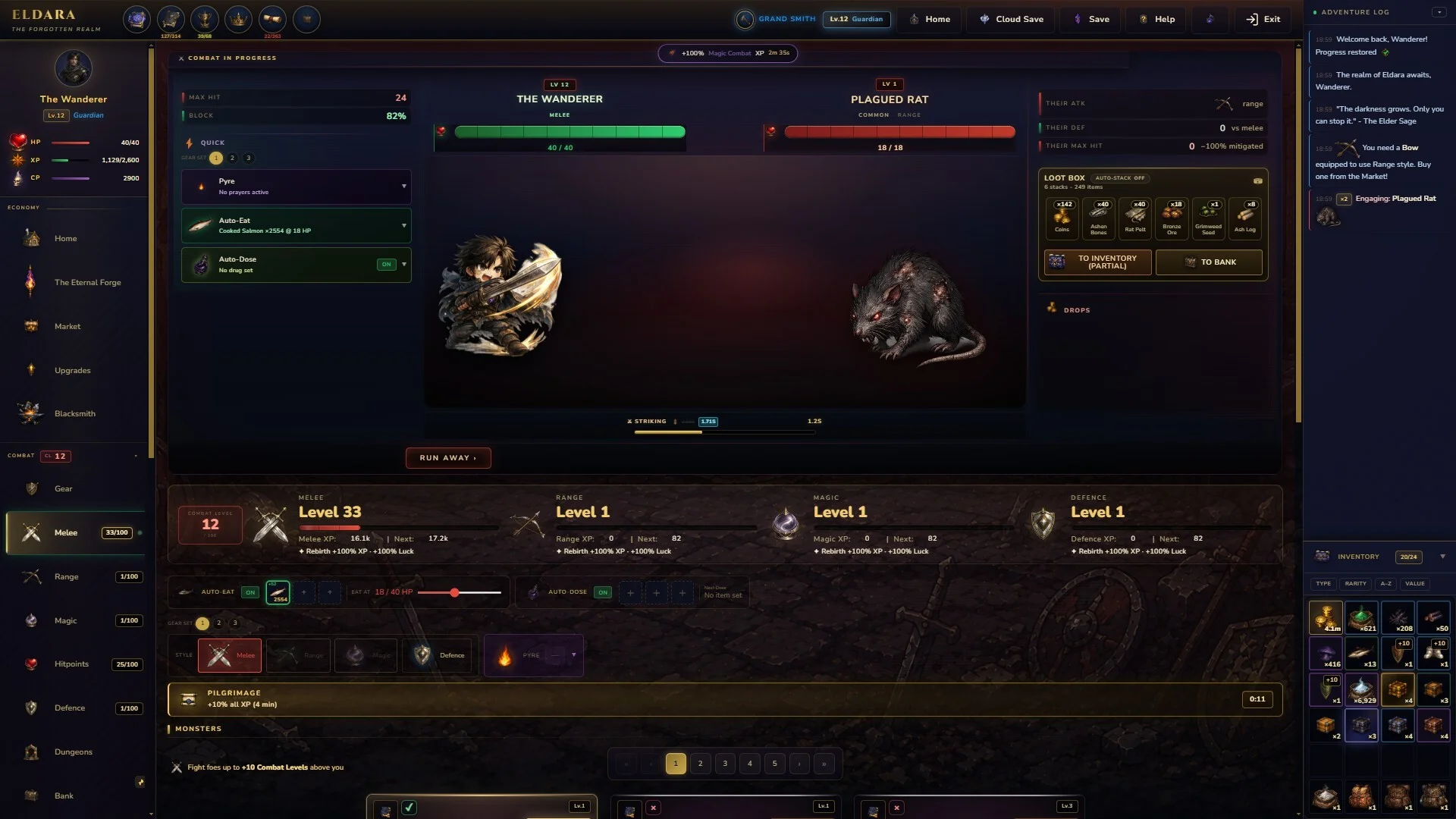
- Eldara gameplay centers on idle progression, skill training, hunting, gathering, crafting, and offline gains.
- Start with connected skills so gathered materials can support equipment, recipes, and future upgrades.
- Use offline progress by setting a clear activity before leaving, then returning to collect accumulated progress.
- Pets matter because each companion provides a permanent bonus tied to its skill domain.
- Long-term goal: Build enough knowledge, gear, and resources to challenge the Void.
Eldara gameplay: Core Progression Loop
Eldara gameplay is built around a dark fantasy idle RPG structure where the world continues progressing while you are away. Instead of relying on constant active input, you choose an activity, allow the character to train or gather, and return later to improve the account.
The main loop combines 17 interconnected skills, monster hunting, resource collection, crafting, equipment upgrades, pet bonuses, and encounters throughout the realm. Each system supports another part of progression, so a strong account is usually built through several complementary activities rather than one isolated skill.
Train
Develop one of 17 skills and work toward its passives and milestones.
Gather
Collect materials through activities such as fishing, mining, herbal cultivation, and other resource skills.
Craft
Turn materials into gear, arrows, potions, and other useful items through connected production paths.
Hunt
Defeat monsters, gather rare drops, and prepare for stronger encounters and the Void.
| Progression Stage | Main Focus | Useful Result |
|---|---|---|
| Foundation | Train basic skills and gather materials | Reliable resource income |
| Development | Connect gathering with crafting | Better equipment and consumables |
| Combat Growth | Hunt monsters and collect drops | Gear materials and progression |
| Optimization | Select activities around current goals | More efficient idle sessions |
| Endgame Preparation | Improve skills, pets, and equipment | Stronger readiness for the Void |
Choose activities that support your next upgrade. A gathering session is more valuable when its materials directly feed a recipe, weapon improvement, or combat objective.
The most useful early habit is to think in chains. Mining can support smithing, monster drops can support crafting, and skill milestones can improve future activity efficiency. Before starting an idle session, identify what you need next and select the activity that moves that objective forward.
Step-by-Step Eldara Gameplay Setup
A good idle setup does not require complicated micromanagement. The important decision is selecting an activity that matches your current stage of progression. Follow this process whenever you begin a longer session.
Define the Next Upgrade
Decide whether your immediate goal is a skill milestone, a crafting recipe, stronger gear, a pet unlock, or preparation for a difficult hunt. Avoid starting an activity without a clear purpose.
Check the Resource Chain
Review the materials required for that goal. If the recipe depends on ore, herbs, hides, bones, or other drops, prioritize the activity that supplies the missing resource.
Select the Best Training Activity
Set the skill or gathering activity that directly supports your target. When several options are available, prefer the one that advances both progression and your current crafting or combat plan.
Leave the Game Running Its Course
Eldara supports progress at your own pace, including offline advancement. Once the activity is selected, step away and return when you are ready to collect results and make the next decision.
Convert Gains Into Progress
Spend gathered materials on the upgrade that motivated the session. Then reassess your next goal instead of repeating the same activity automatically.
| Setup Question | Recommended Decision |
|---|---|
| What do I need next? | Identify one upgrade, milestone, recipe, or hunt |
| Which material is missing? | Train or gather the activity that provides it |
| Can the session run unattended? | Use offline progress for longer-term advancement |
| What should happen after returning? | Craft, upgrade, unlock, or begin the next resource cycle |
Idle systems can accumulate resources without solving your current bottleneck. If a session does not support a clear skill, crafting, or combat objective, reconsider the activity before committing time.
This setup works especially well because Eldara includes save-anytime accessibility and a pace designed for players who do not want constant quick-time inputs. You can make progress through short check-ins or longer offline intervals, depending on how actively you want to manage the realm.
Skills, Crafting, and Resource Planning
Eldara’s 17 skills form the backbone of its progression economy. The available skill descriptions identify combat, magic, fishing, mining, fletching, bone cremation, and ancient herb cultivation among the activities that shape the character’s development.
Rather than treating every skill as a separate track, plan them as a resource network. Gathering creates inputs, production skills transform those inputs, and combat activities provide additional materials and objectives.
| Skill or Activity | Primary Role | Planning Use |
|---|---|---|
| Melee | Close-range combat progression | Supports direct monster hunting |
| Magic | Spell-focused combat progression | Builds an alternative combat path |
| Fishing | Resource gathering | Supplies materials from cursed waters |
| Mining | Ore and deep-vein gathering | Supports smithing and equipment creation |
| Fletching | Arrow production | Converts materials into ranged ammunition |
| Bone Cremation | Beast-material processing | Gives collected bones a crafting purpose |
| Herb Cultivation | Ancient plant production | Supports preparation and resource variety |
| Crafting Stations | Item production | Turns gathered materials into useful upgrades |
The best approach is to create a simple production priority:
- First, identify the equipment or consumable you want.
- Second, list the materials needed for that item.
- Third, choose the gathering activity that fills the largest gap.
- Fourth, process the materials at the appropriate crafting station.
- Finally, return to combat or skill training with the new upgrade.
Hundreds of items, recipes, and crafting paths are available, so resource storage should be treated as part of progression rather than an afterthought. Common materials may become important later, while rare monster drops can be tied to higher-value upgrades.
Use crafting to remove a current weakness. Improving the item that blocks your next hunt or skill milestone usually gives more practical value than producing upgrades without a specific purpose.
The system also rewards players who rotate activities. A single skill may be useful in isolation, but connected training creates a more flexible account. For example, a resource-focused period can prepare materials, followed by crafting, then a hunting session to test the improved setup.
For new players, avoid trying to master every skill at the same time. Keep one primary development path, one supporting gathering path, and one practical crafting objective. Expand your rotation after the first cycle begins producing consistent results.
Combat, Pets, and Long-Term Builds
Combat progression in Eldara revolves around hunting monsters across crumbling kingdoms and forgotten ruins. Victories provide bones, hides, and rare materials, which can then feed into crafting and equipment upgrades. Every hunt should therefore be judged by both its immediate combat value and the resources it returns.
The game features 17 unique pets, with one companion associated with each mastered skill. Named examples include Steelfang, a wolf pup; Sharpeye, a hawk; Whisper, a spectral familiar; and Sprout, a seedling. Each pet grants a permanent bonus connected to its domain.
Combat-Focused Build
Prioritize Melee or Magic development, then use hunting rewards to improve equipment and access stronger encounters.
Production-Focused Build
Develop gathering and crafting connections first, creating a dependable flow of materials for future upgrades.
Balanced Build
Rotate combat, gathering, and production so no single system becomes the main progression bottleneck.
| Build Direction | Strength | Main Consideration |
|---|---|---|
| Melee Path | Direct combat identity | Requires reliable gear and hunt preparation |
| Magic Path | Spell-based progression | Benefits from focused skill development |
| Gathering Path | Strong material foundation | Combat milestones may arrive more slowly |
| Crafting Path | Better control over upgrades | Depends on maintaining material supplies |
| Balanced Path | Flexible across systems | Requires more active planning between sessions |
Treat pet unlocks as permanent account improvements. When choosing between similar activities, consider whether one path also moves you closer to a companion and its long-term skill bonus.
The most practical combat preparation is simple: strengthen the relevant skill, craft or improve suitable equipment, and ensure that your resource cycle can replace materials after a hunt. Stronger enemies should be approached as part of a progression test rather than as the only way to advance.
The realm also includes random encounters, traveling merchants, town criers, whispered subplots, and shadowy strangers. These events add variety to the routine and can provide reasons to check the world even when your main activity is running in the background.
Daily Routine and Progress Checklist
Eldara is designed for flexible play. Its offline progression and “play at your own pace” structure make it suitable for brief daily check-ins as well as longer sessions. The following routine keeps progress organized without requiring a rigid schedule.
Core Progression Checklist:
- Choose one clear upgrade or skill milestone before starting an activity
- Check which materials are missing from the next crafting objective
- Set a training or gathering activity before leaving the game
- Review combat gear and pet bonuses before a difficult hunt
- Spend collected materials and define the next progression cycle
| Check-In Moment | What to Review | Suggested Action |
|---|---|---|
| Start of session | Current bottleneck | Set the activity that addresses it |
| After offline progress | Materials and skill gains | Craft, upgrade, or redirect training |
| Before hunting | Equipment and relevant skill | Prepare for the intended monster tier |
| After crafting | New gear or consumables | Test the upgrade during the next activity |
| End of session | Next objective | Leave a useful activity selected |
Use the routine as a decision framework rather than a strict timetable. Eldara does not require every player to follow the same order, and the best activity depends on what your account currently lacks.
A one-time purchase model with no microtransactions is listed for the game, while accessibility options include adjustable difficulty, save-anytime functionality, custom volume controls, and play without quick-time events. These features support a slower, more deliberate progression style.
Short sessions are still productive when you finish with a useful activity selected. The next offline interval should begin immediately after your last upgrade or resource decision.
For current ownership, release, feature, and system information, consult the official Eldara Steam store page. The listed version 1.0 launch date is September 2, 2026, following an Early Access release on June 15, 2026.
Eldara Gameplay Goals and FAQ
Long-term progress is measured through skill mastery, crafting depth, pet collection, equipment quality, exploration, and combat readiness. The game lists 68 Steam Achievements, giving completion-focused players an additional set of milestones beyond ordinary skill growth.
| Long-Term Goal | Progress Indicator |
|---|---|
| Skill mastery | Skill levels, passives, and milestones |
| Pet collection | Unique companions and permanent bonuses |
| Crafting growth | Recipes, items, and production paths |
| Combat readiness | Gear quality and successful monster hunts |
| World discovery | Encounters, merchants, subplots, and secrets |
| Achievement progress | Listed achievement objectives |
Keep goals measurable. “Get stronger” is too broad, while “complete the next skill milestone,” “craft the needed equipment,” or “unlock another skill-linked pet” gives the next session a clear direction.
Q: What is the main focus of Eldara gameplay?
Eldara gameplay focuses on idle progression through 17 skills, gathering, crafting, monster hunting, pet bonuses, exploration, and offline advancement.
Q: How does offline progress work in Eldara?
You select an activity before stepping away, and the game continues progressing at your chosen pace. When you return, review the gains and use them for crafting, upgrades, or the next activity.
Q: Which skills should new players prioritize?
Prioritize the skills that support your immediate goal. Gathering skills help supply materials, crafting converts those materials into upgrades, and Melee or Magic can support combat development.
Q: Do pets provide permanent benefits?
Yes. Eldara lists 17 unique pets, with each companion granting a permanent bonus related to its skill domain.
The strongest Eldara gameplay routine is a repeating cycle: define a goal, gather what it requires, craft or upgrade, test the result, and leave the next useful activity running.
Eldara rewards steady planning more than rushed decisions. By connecting skills to resources, resources to crafting, and crafting to combat preparation, you can build a flexible account while letting offline progress handle part of the workload. Keep your next milestone visible, use pets as lasting improvements, and treat each return to the realm as an opportunity to refine the next cycle.